

What should university campus cleaning services cover when lecture halls, residence buildings, libraries, and administrative offices place different demands on a cleaning plan? A single routine can leave busy spaces under-served and quieter areas over-scheduled. Campus leaders need a plan that keeps high-traffic environments orderly while reflecting how each building is used.
The clearest plan starts with priorities, not a one-size-fits-all checklist. This guide explains how to map needs by building, define a practical scope and visit frequency, and compare plans using criteria that make sense for your campus. You’ll also learn how Way Beyond Cleaning’s educational facility cleaning and commercial janitorial services can support a recurring arrangement tailored to square footage and service frequency. With those details in hand, your team can discuss what matters and how each campus space should be cared for.
Key Takeaways
- Shape university campus cleaning services around how each building is used, rather than relying on one checklist for every space.
- Separate recurring janitorial tasks from periodic or project-based work to make the scope easier to understand.
- Compare plans by scope clarity, visit frequency, communication, and adaptability. Square footage and frequency can help inform a tailored agreement.
- Prepare for a service discussion by mapping campus spaces, ranking priorities, and outlining timing and square footage.
- Way Beyond Cleaning provides educational facility cleaning and commercial janitorial services in Fairfield, Litchfield, and New Haven Counties, and Westchester County.
Why university campus cleaning services need a campus-specific plan
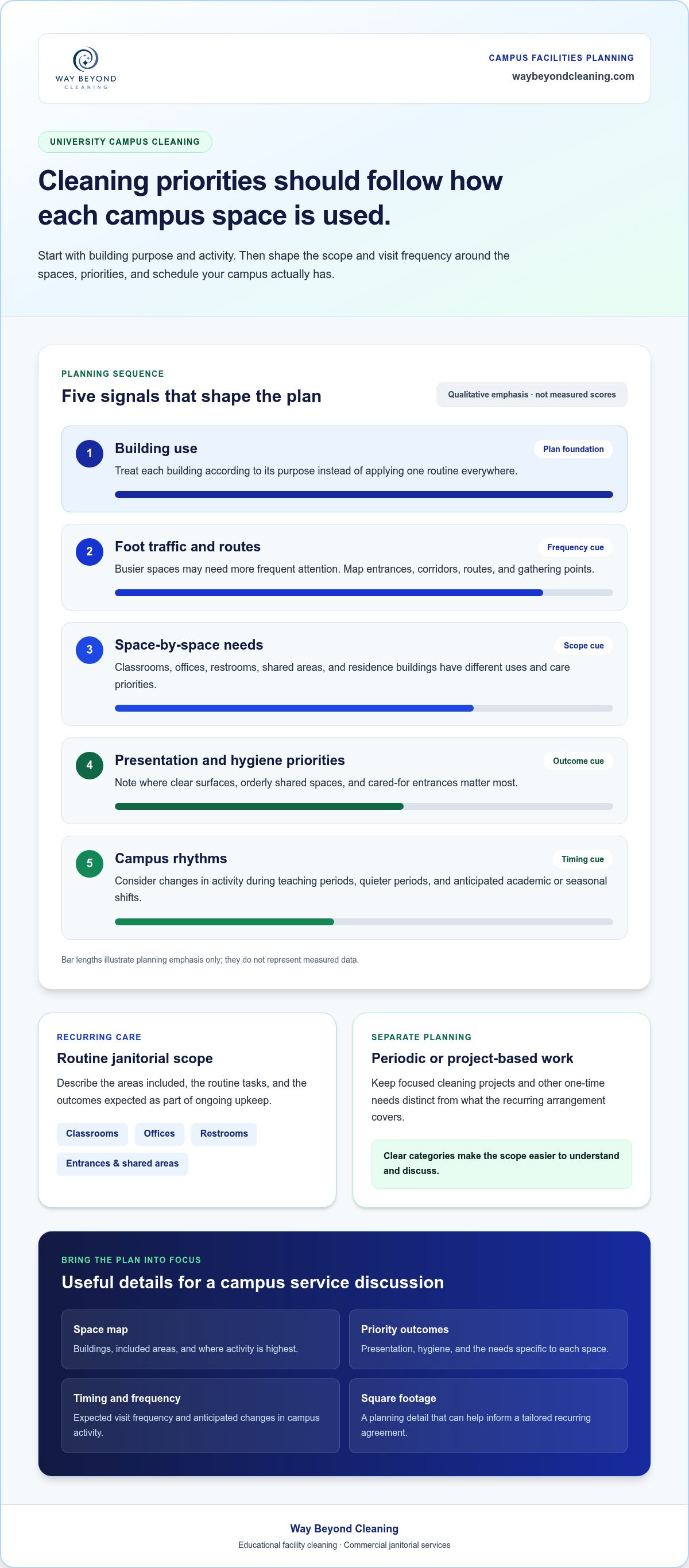
Facilities teams balance daily presentation, changing foot traffic, and the practical demands of coordinating care across multiple buildings. A campus may look orderly at the start of the day, then feel very different after classes, meetings, and shared spaces fill with people. A useful cleaning plan accounts for those shifts instead of treating every room as if it serves the same purpose.
University campus cleaning services are a tailored commercial plan that matches recurring janitorial care to the spaces, activity, and priorities of a campus. Recurring service supports regular upkeep, while one-time or project-based cleaning addresses a specific need outside the ongoing scope. Defining both helps facilities teams clarify what should happen routinely and what should be planned separately.
How campus activity changes cleaning priorities
Teaching days can bring steady movement through entrances, corridors, classrooms, and shared areas. During quieter periods, use patterns may shift, but buildings still need attention suited to their purpose. Foot traffic is a practical planning signal: spaces used by more people may need more frequent attention than rooms with limited daily use. Reviewing routes and gathering points can help teams identify where consistent presentation matters most.
Visible cleanliness shapes how students, staff, and visitors experience a campus. Clear surfaces, tidy shared spaces, and cared-for entrances can help a building feel ready for learning and work. The aim isn’t to make every room look identical. It’s to give each space the level of care that fits its use.
Which campus spaces belong in the conversation?
Start with the spaces facilities teams manage every day: classrooms, offices, restrooms, entrances, corridors, and common areas. For each one, consider its use, foot traffic, and presentation or hygiene priorities. Shared living spaces in residential buildings have different needs from teaching areas. For more context on the setting, see this general overview of dormitory cleaning.
Use these examples as planning prompts, not as a fixed checklist. The service scope should reflect the facility’s priorities and the areas included in its recurring plan. Listing spaces individually makes the conversation more specific: a classroom may need routine upkeep, while a busy corridor may merit particular attention because people pass through it throughout the day.
To get started, map campus buildings and note which spaces see the most activity, where presentation matters most, and which tasks belong in regular janitorial care. Then distinguish ongoing needs from one-time or project-based work. This gives decision-makers a clear basis for discussing scope and frequency without assuming every building needs the same routine.
Way Beyond Cleaning provides educational facility cleaning and commercial janitorial services. For Fairfield County institutions, a campus-specific discussion can focus on facility priorities and recurring care needs. Explore commercial janitorial services to see how those needs can shape the conversation.
What university campus cleaning services can cover
A campus cleaning scope should describe what happens routinely, which areas are included, and what outcomes matter to the facility. It’s more than a task list. A clear scope connects each task to the way a building is used, so expectations are easier to discuss and recurring care can be planned with purpose.
Routine janitorial service supports ongoing upkeep. Periodic or project-based work addresses needs outside the regular plan, such as a focused cleaning project. Separating these categories helps decision-makers see what the recurring arrangement covers and which needs should be planned separately. The University of Texas at Austin’s overview of university cleaning service levels offers an example of how campus cleaning needs can be organized by type.
Build a scope around the spaces people use
Describe each area in practical terms, then note its priorities. A specific scope is easier to understand than a broad request to “clean the building.”
- Classrooms: Identify the rooms and the routine presentation needs that help keep learning spaces ready to use.
- Offices: Clarify which office areas are included and what general upkeep matters to staff.
- Restrooms: Name the locations and describe the routine attention the facility expects.
- Entrances and shared areas: Note the routes and gathering spaces where orderly surfaces and a welcoming first impression matter.
Be specific about areas, surfaces, and expected results, while keeping the scope aligned with the facility’s priorities. Don’t assume specialized or regulated environments fall within a general janitorial plan. Define ordinary spaces first, then identify any distinct requirements clearly in the service discussion.
Match recurring service to campus rhythms
Map priority areas to expected use. A classroom wing may be active during teaching periods, while offices or shared spaces follow a different pattern. Frequency is a planning choice, not a universal standard. It should reflect the spaces included, how they’re used, and the outcomes the facility wants to maintain. If activity changes with the academic calendar or season, include those anticipated shifts in the discussion.
Way Beyond Cleaning tailors recurring commercial agreements to square footage and visit frequency. Sharing those details alongside a space-by-space scope helps shape a plan around the campus, rather than forcing varied buildings into an identical routine. To learn more about commercial janitorial services in Fairfield, CT, consider how your facility’s areas and expected frequency can inform a tailored service discussion.
A useful working scope defines routine care, distinguishes project-based needs, and accounts for changing campus rhythms. That clarity helps facilities teams discuss expectations with less guesswork and focus attention on the spaces that support campus life.
How to compare university campus cleaning service plans
Look beyond broad assurances such as “complete campus care.” A useful comparison shows which areas are covered, how often service is expected, how to communicate changing needs, and how the plan accounts for buildings with different activity levels. Those details help facilities teams compare the proposed service, not just the language used to describe it.
A written scope gives campus teams and their janitorial partner a shared reference for routine service and consistent expectations. Use the table below to organize a plan review and identify where a proposal needs more detail.
| Comparison point | What to look for | Useful question |
|---|---|---|
| Scope clarity | A defined area list with concrete tasks or expected outcomes, rather than general promises. | Can facilities teams tell which spaces are included? |
| Visit frequency | A proposed pattern that reflects the priorities and expected use of each area. | Does the frequency align with the needs identified for these spaces? |
| Communication | A clear way to share observations and discuss changing facility needs. | Can the team raise a new priority and discuss its effect on the scope? |
| Adaptability | A plan shaped around the campus, rather than assuming each building needs identical attention. | Can differences in building use inform the service discussion? |
Compare scope, frequency, and communication
Start with the area list. A proposal that names classrooms, offices, restrooms, entrances, and shared spaces gives decision-makers a more practical basis for comparison than one that promises to clean “all facilities.” Then compare the proposed visit pattern with the priorities already set. If an area is central to daily campus use, the plan should show how its expected care is addressed. ISSA’s guidance on best practices for university cleaning can also help frame why a thoughtful, consistent approach matters.
Communication belongs in the comparison, too. Campus use can shift, so facilities teams need a direct way to describe what has changed, share observations, and discuss whether the service scope should be revisited. Clear communication reduces guesswork, but it doesn’t mean every request automatically changes the arrangement.
Look for a plan that can adjust to the campus
Buildings with different activity levels may call for different priorities. Square footage and visit frequency are practical inputs to a recurring agreement, alongside the areas and outcomes the campus identifies. Adaptability means the discussion can account for those differences, not that a provider promises a particular change in advance. For a local reference point, explore commercial janitorial services in Fairfield, CT and consider how your campus priorities can inform a tailored service discussion.
University campus cleaning services are easier to assess when the scope, frequency, communication approach, and flexibility are described in concrete terms. That makes it simpler to compare what each arrangement is designed to deliver and identify questions that still need clear answers.
Plan a campus cleaning service discussion in four steps
A focused service conversation is easier when campus needs are gathered in one place. You don’t need a complicated facilities report. A simple map, a short priority list, and realistic timing expectations can turn broad concerns into a useful discussion about scope, square footage, and visit frequency.
- Map the spaces. Group buildings and rooms by use, foot traffic, and the outcomes that matter most. Note classrooms, offices, restrooms, entrances, and shared areas separately when their needs differ. Mark locations that may need distinct attention so they can be discussed specifically. Identify the campus contact who can explain priorities and access expectations for the spaces in scope.
- Rank the priorities. Decide which concerns deserve the most attention first. For example, a heavily used entrance may be a higher presentation priority than a room with limited activity, while a restroom may have distinct routine-care expectations. Recording the reason behind each priority keeps the discussion grounded in campus operations rather than general requests such as “clean more thoroughly.”
- Outline timing. Gather the approximate square footage of the areas under consideration and describe the visit frequency you want to discuss. Note when activity typically rises or falls, including high-activity periods and academic breaks. These details help explain how campus use may shape a recurring arrangement. Include known scheduling constraints so timing can be considered alongside scope.
- Discuss the scope. Bring the map, priorities, square footage, and timing expectations together. Describe the areas to include, the routine outcomes you want, and how facilities staff will communicate changes in building use or service priorities. Keep the conversation focused on practical operating needs, and distinguish recurring janitorial care from separate project-based work. A clear starting point makes it easier to shape an arrangement around the facility.
This preparation gives both sides a more concrete foundation than a request based only on total building size. Way Beyond Cleaning tailors recurring commercial agreements to square footage and visit frequency, so sharing those details helps focus the conversation on your campus’s needs. If your team is preparing for a local service discussion, review commercial cleaning services in the context of your mapped spaces, priorities, and timing expectations.
For university campus cleaning services, the goal of these four steps is clarity: a shared picture of the spaces, a sense of priority, and a practical basis for discussing recurring care. That preparation helps facilities teams use their time well and move toward a scope that reflects how the campus operates.
Bring university campus cleaning services together with a local partner
A campus plan becomes more practical when the discussion starts with people who understand how its buildings are used. Way Beyond Cleaning provides educational facility cleaning and commercial janitorial services in Fairfield, Litchfield, and New Haven Counties in Connecticut, as well as Westchester County in New York. For Fairfield County institutions, that local connection supports a focused conversation about campus priorities, the spaces to include, and the recurring care the facility needs.
University campus cleaning services shouldn’t rely on a single routine for every building. A useful service discussion connects each facility’s needs to a clear scope and expected visit frequency, helping decision-makers consider how recurring care fits their operations.
Why a tailored local service discussion helps
Describe the campus in operational terms: which buildings are included, how their spaces are used, and where consistent presentation matters most. Include the priorities facilities staff want a recurring plan to address. This creates a grounded conversation about the work rather than a broad request based only on the word “campus.”
Way Beyond Cleaning tailors recurring commercial agreements around square footage and visit frequency. Those details, alongside the facility’s priorities, help shape a service arrangement suited to the campus under discussion. For Fairfield County facilities, a local conversation can keep planning focused on the buildings and needs relevant to the location, without assuming every space has the same requirements.
Take the next step toward a clearer campus plan
Before discussing a proposal, gather a concise overview of the campus. Include the buildings and areas you want considered, the priorities that matter most, approximate square footage, and preferred service frequency. Note anticipated changes in campus activity, such as quieter academic breaks or busier periods, so they can be part of the planning conversation.
A short list can help organize the details:
- Buildings and spaces: Identify the facilities and areas to include in the discussion.
- Priority needs: Describe the outcomes that matter to your campus team.
- Timing expectations: Share preferred visit frequency and relevant scheduling considerations.
Way Beyond Cleaning provides commercial and educational facility cleaning shaped around campus requirements. Bring your priorities and facility details to the conversation, then explore how a tailored recurring arrangement can support a more orderly, welcoming environment for the people who learn and work there. Discuss your campus cleaning priorities with Way Beyond Cleaning.
Give your campus a clearer path forward
A thoughtful cleaning arrangement can do more than maintain appearances. It can help create campus spaces that feel cared for and ready for the people who learn, work, and gather there. Treat the service scope as a practical reference for facilities decisions, one that can be revisited as priorities evolve rather than a checklist that sits untouched after it’s agreed.
With university campus cleaning services, clarity at the start gives your team a stronger foundation for a lasting working relationship. Decide what a well-cared-for campus should feel like for its community, then use that vision to guide the next conversation about service.
Way Beyond Cleaning supports educational facilities with commercial janitorial care. Discuss your campus cleaning needs with Way Beyond Cleaning and take the next step toward a plan shaped around your facility.
Frequently Asked Questions
What do university campus cleaning services typically include?
University campus cleaning services typically cover recurring janitorial tasks defined by the facility’s needs. A plan might include routine care for classrooms, offices, restrooms, entrances, and shared areas, with the exact work set out in the agreed scope. A campus team can identify which locations need attention and what a ready-to-use space should look like. One-time or project-based cleaning can be planned separately from ongoing upkeep.
Can a cleaning plan be tailored to different buildings across a university campus?
Yes. A campus plan can account for differences between buildings instead of assigning every space the same routine. A lecture building, administrative office, and residence hall may have distinct patterns of use and priorities. Describe those differences in the service discussion, including the areas to cover and their intended outcomes. Way Beyond Cleaning provides educational facility cleaning and tailors recurring commercial agreements to the facility’s square footage and visit frequency.
How should a university decide how often campus spaces need cleaning?
Base frequency on how spaces are used and the level of care the campus wants to maintain. Consider regular occupancy, traffic through shared areas, and how quickly a space needs to be ready for its next use. A busy common area may have different needs from a lightly used office. Gather these observations by area, then use them to discuss a practical recurring frequency rather than assuming one schedule suits every building.
Can campus cleaning be scheduled around classes and academic breaks?
Campus timing can be part of the service discussion. Share when buildings are typically busy, when access may be limited, and whether activity changes during academic breaks or other quieter periods. These details help frame expectations for the proposed arrangement, though they don’t establish a particular schedule by themselves. For instance, a facilities team can flag a period of reduced room use and discuss whether that changes the priorities for spaces included in the plan.
What is the difference between janitorial and custodial services?
The terms often overlap, and their meaning can vary by organization. “Janitorial” commonly refers to routine cleaning and upkeep, while “custodial” may describe a broader facilities role that can include cleaning alongside other building-support responsibilities. For a service discussion, focus less on the label and more on the work: list the spaces, tasks, and outcomes your campus expects. That makes the scope easier to understand and compare.
How can a university request a commercial cleaning service discussion?
Prepare a short campus overview before starting the conversation. Include the Fairfield County facility’s buildings and spaces, approximate square footage, priority needs, and preferred visit frequency. It also helps to identify a campus contact who can explain how the spaces are used and share relevant timing considerations. With those details in hand, Way Beyond Cleaning can discuss educational facility cleaning and a recurring commercial arrangement shaped around your campus priorities.
Do university campus cleaning services cover student housing?
Student housing can be included in a campus cleaning discussion, with the proposed scope shaped by the facility’s priorities and the areas it wants covered. A residence hall may include shared entrances, corridors, lounges, and other common spaces, each with different patterns of use. Identify which areas are part of the request and describe the desired routine care. This helps distinguish shared-space needs from any separate arrangements for individual rooms.


