

A well-kept childcare facility needs a cleaning plan that fits the way children and staff use it. When choosing childcare and daycare cleaning services Norwalk facilities can rely on, start by mapping the rooms, their daily uses, and the times they are available. That makes it easier to define practical priorities without disrupting activities.
Before comparing services, decide what the regular scope should cover, how often different areas need attention, and how schedule changes will be communicated. For example, a classroom used throughout the day may need a different plan from a reception area or a room used occasionally. A written scope helps your team and cleaning provider share the same expectations.
This guide explains how to set priorities, define a useful scope, compare service arrangements, and plan cleaning around daily operations. Way Beyond Cleaning provides educational facility cleaning in Fairfield County, including Norwalk, with a plan tailored to each facility’s rooms, routines, and needs. The aim is dependable upkeep that helps your space feel organized and welcoming for children, staff, and families.
Key Takeaways
- Separate recurring upkeep from occasional tasks so your facility has a clear, practical cleaning scope.
- Compare childcare and daycare cleaning services Norwalk by scope, schedule fit, communication, and consistency.
- Plan cleaning windows around drop-off, activities, meals, and closing routines to reduce disruption.
- List each room, its uses, and its priorities before setting a schedule, then review the plan as needs change.
- A tailored commercial janitorial plan can help your childcare facility maintain an orderly, welcoming environment for children, staff, and families.
Why Childcare and Daycare Cleaning Services Matter in Norwalk
Childcare directors balance a welcoming setting with the practical demands of a busy facility. Rooms move from arrival and play to meals, learning, and rest, while staff have limited time to coordinate around cleaning. A tailored plan accounts for those routines instead of treating every room and hour as if they serve the same purpose.
Families see the entrance and reception area as they arrive. Staff rely on classrooms and shared rooms being ready for the day’s activities, and restrooms contribute to the facility’s overall appearance. Each space has its own use, traffic, and place in the schedule. Mapping those differences helps you set priorities and choose cleaning times that fit how the center operates.
A facility-specific cleaning scope turns a general routine into a practical plan based on your rooms, priorities, and operating rhythm. That distinction matters when comparing childcare and daycare cleaning services Norwalk facilities may need. Look for a plan that identifies the areas included, describes recurring expectations, and fits the center’s schedule. For broader context on why shared settings make hygiene a relevant consideration, see Infection in childcare. This guide focuses on organizing facility cleaning, not promising health outcomes.
Which spaces shape the first impression of a Norwalk daycare?
First impressions come from several connected spaces. The entrance and reception area welcome families, classrooms and shared rooms shape the experience of the day, and restrooms affect the facility’s overall sense of care. Walk through the center as a family would, then note visible surfaces, busy routes, and areas that tend to look untidy between scheduled cleanings. This simple review can help you rank priorities by visibility and use.
How does cleaning support everyday childcare operations?
A well-organized cleaning schedule supports day-to-day operations when it works around the center’s routine. Arrival periods, activities, meals, and closing all affect when rooms are occupied and available. Way Beyond Cleaning provides commercial janitorial and educational facility cleaning in Fairfield County, including Norwalk, tailored to each facility. Its commercial cleaning services can be planned around your rooms, priorities, and operating schedule.
What Childcare Cleaning Services in Norwalk Should Cover
Childcare cleaning works best as a commercial janitorial plan shaped around the facility, rather than a preset checklist applied identically everywhere. Define the scope by considering which rooms children and staff use, how often they are used, and when they are available for cleaning. This gives directors a clear basis for setting expectations and planning upkeep around the center’s real routines.
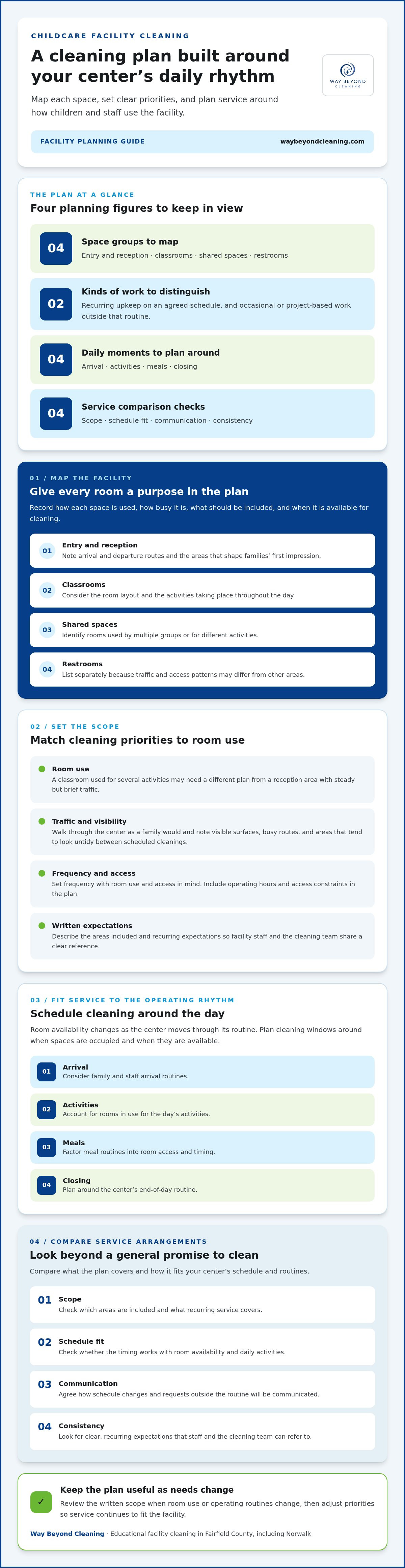
Start by listing the rooms, then identify what matters in each one. A useful overview might group spaces like this:
- Entry and reception areas: Identify the routes families and staff use as they arrive and leave, along with the areas that affect the first impression.
- Classrooms: Note how room layout and daily activities shape cleaning priorities.
- Shared spaces: Identify rooms used by multiple groups or for different activities throughout the day.
- Restrooms: List them separately because their traffic and access patterns may differ from other areas.
How should a daycare map its spaces and cleaning priorities?
For each room, record how it is used, how busy it is, and which areas your facility wants included in the routine scope. A classroom used for several activities may need a different plan from a reception area with steady but brief traffic. Way Beyond Cleaning tailors commercial service to each facility, helping align the scope with its rooms, routines, and priorities.
Set frequency by considering room use and access, rather than assuming one schedule suits the whole center. A heavily used area may need attention more often than a room used occasionally, while changes in the timetable can affect when cleaning is practical. Include each room’s operating hours and access constraints in the plan. Way Beyond Cleaning’s commercial cleaning services provide a starting point for discussing a facility-specific janitorial scope.
What belongs in recurring janitorial service versus occasional work?
Recurring service is upkeep carried out on an agreed schedule and within a defined scope. Occasional or project-based work addresses a particular need outside that routine. Keeping the two categories separate helps directors understand what the ongoing plan covers and which requests should be treated as separate projects.
For example, a center might define routine expectations for regularly used rooms, then note a separate request if a room changes purpose or needs focused attention beyond the usual plan. These are planning examples, not a standard package. Describe the area, the requested result, and the timing so the scope remains clear. The Fairfield commercial janitorial guide offers further context on how commercial janitorial service can support a well-kept workplace.
A written scope gives staff and the cleaning team a shared reference. Review it when room use or operating routines change, and adjust priorities so the service continues to fit the facility.
How to Compare Daycare Cleaning Services in Norwalk
A useful comparison goes beyond a general promise to keep a facility clean. Directors need to know what the plan covers, whether its timing fits the center’s activities, and how expectations will be communicated. In childcare spaces, the best operational fit comes from matching the plan to how rooms are used, not disrupting the day with a schedule that ignores those routines.
Compare scope and operational fit together. Use the framework below to identify practical differences between service arrangements:
| Area | What to compare | Why it matters |
|---|---|---|
| Scope | How clearly the plan describes facility areas and priorities | Specifics make it easier to see whether the arrangement reflects the center’s needs. |
| Schedule fit | How proposed cleaning times relate to normal activities and access | Well-matched timing can reduce friction with the daily routine. |
| Communication | How expectations, changes, and requests are organized | Clear shared expectations help staff understand the plan. |
| Consistency | How the recurring scope and schedule are documented for reference | A defined plan gives both sides a common basis for reviewing service. |
Which service-plan details help a daycare compare options?
Look for a scope that names the center’s main areas and priorities instead of relying on a vague description. Check whether timing fits typical room use and access, and whether expectations are clear from the outset. For example, a classroom used throughout the day and a reception area with a different traffic pattern may need distinct priorities in the plan.
Include communication in your comparison. Staff should understand how the agreed scope is documented and how to raise a change when room use or priorities shift. This does not require an elaborate process, but it does require clear expectations. When the details are defined, it is easier to judge each arrangement on practical fit rather than on a broad service description.
How can a cleaning plan reflect child-centered concerns?
Describe how children and staff use each area, which routines affect access, and what your facility considers a priority. That context gives the cleaning plan a more useful foundation than a generic template. Keep the comparison focused on scope and operational fit. Do not assume a particular product, method, or room re-entry window unless those details have been established for the project.
Way Beyond Cleaning tailors commercial service to each facility rather than applying one universal plan. For a Norwalk center, planning starts with its rooms, priorities, and daily rhythm, then shapes the cleaning scope around those needs. Explore commercial cleaning services as a starting point for a facility-specific plan.
How to Plan a Childcare Cleaning Schedule in Norwalk
A workable schedule starts with the center’s daily pattern, not a preset frequency. Mapping rooms, priorities, and access windows gives directors a clear basis for planning routine upkeep around the flow of the day. Use this sequence to develop a plan for your facility:
- Inventory the spaces. List classrooms, entrances, reception areas, shared rooms, restrooms, and other facility spaces. Note which areas and surfaces you want included in each room’s scope.
- Describe how each room is used. Record whether a space hosts regular activities, serves several groups, or sees occasional use. This helps distinguish high-use areas from rooms with different needs.
- Identify recurring and periodic tasks. Separate the upkeep you expect to repeat from tasks that arise occasionally or when room use changes. This makes the regular plan easier to understand.
- Mark operating and access patterns. Note drop-off and pick-up, activities, meals, rest periods, and closing routines. Identify when rooms are occupied or otherwise unavailable so cleaning can be scheduled around the center’s operations.
- Set priorities and review the schedule. Use room use and facility priorities to decide what needs regular attention and when. Revisit the plan when activities, access, or space use shifts.
What information should facility leaders organize before planning?
Bring together the room inventory, operating patterns, and priority areas before setting timing. Include shared spaces, surfaces that need attention, and constraints that affect access or could interrupt daily operations. For example, a classroom may be occupied during activities but available at another point in the schedule. Recording these details turns general expectations into a practical plan.
Frequency should reflect the facility, not a universal rule. A space used heavily throughout the day may need a different cadence from one used intermittently. Set realistic expectations for each area, then fit cleaning windows around the center’s routines. This is especially useful when coordinating childcare and daycare cleaning services Norwalk facilities rely on without disrupting the people who use those spaces.
How can the cleaning plan adapt as facility needs change?
Room use and schedules can evolve, so treat the plan as a working reference. Review periodically whether priorities still match the facility’s operations, and communicate changes clearly so service expectations stay aligned. If a room is assigned a different activity, for instance, reconsider its place in the scope or schedule.
Way Beyond Cleaning tailors commercial service to each facility’s rooms, operating rhythm, and priorities. Explore educational facility cleaning as part of a tailored commercial plan for your Norwalk center.
Choose Tailored Childcare Cleaning Services for Your Norwalk Facility
A dependable cleaning arrangement should suit the facility that uses it. For a Norwalk childcare center, consider four practical factors: the rooms and priorities in the scope, the center’s daily rhythm, clear communication, and whether the plan can be reviewed as needs change. A well-defined arrangement gives directors and staff a shared reference without adding unnecessary complexity to a busy day.
What can a tailored local cleaning partnership offer?
A customized commercial janitorial plan can reflect the rooms a center operates, the priorities it identifies, and a schedule that fits its activities and access patterns. Clear coordination helps staff understand how the agreed scope supports the facility’s routines. Way Beyond Cleaning provides commercial janitorial and educational facility cleaning in Fairfield County, including Norwalk, with service shaped around each facility’s needs.
Tailoring is about fit, not applying a universal checklist. An entry area, classroom, and shared room may have different uses and priorities, so the scope can account for those distinctions. A clear understanding of the plan also gives facility leaders a practical way to discuss changes when room use or schedules evolve. This creates an organized approach to upkeep that supports childcare operations within the agreed service.
What are the next steps for a Norwalk childcare facility?
Start with a concise picture of the facility. List its rooms and shared areas, operating hours, recurring priorities, and schedule constraints that affect access. Use that information to guide a service discussion focused on the center’s needs and preferred timing. A clear starting point helps translate day-to-day operations into a tailored commercial plan.
As needs shift, revisit the scope and communicate changes that may affect priorities or timing. A classroom may take on a new purpose, shared areas may be used differently, or operating patterns may evolve during the year. Keeping those details in view helps the cleaning arrangement stay connected to how the center works.
For childcare and daycare cleaning services Norwalk facilities can shape around their operations, Way Beyond Cleaning offers commercial janitorial service tailored to facility needs. Outline your rooms, schedule, and priorities, then discuss commercial cleaning for your facility.
Give Your Facility a Plan That Can Grow With It
A childcare cleaning arrangement should support the facility’s current routines while allowing for needs to evolve. As schedules shift, reviewing the scope and communicating changes helps keep expectations relevant. That is the value of choosing childcare and daycare cleaning services Norwalk centers can shape around their own priorities.
Consider what would make cleaning fit smoothly into your operation: a scope that reflects how your center works, timing that respects its daily flow, and communication that keeps the arrangement aligned. You do not need to settle every detail before taking the next step. Begin with the priorities that matter most to your team, then build a plan around them.
Way Beyond Cleaning provides tailored commercial janitorial and educational facility cleaning for Norwalk childcare centers. Discuss a tailored cleaning plan for your Norwalk facility and share your facility’s rooms, schedule, and priorities.
Frequently Asked Questions
What do childcare and daycare cleaning services typically include?
They typically involve an agreed commercial cleaning scope shaped around the facility rather than a universal checklist. The plan can identify which rooms and surfaces receive attention, which tasks recur, and what should be treated as a separate request. For example, a center might define expectations for classroom floors separately from shared-area surfaces. Clear descriptions help staff understand what the arrangement covers and identify where priorities need adjustment.
How often should a daycare in Norwalk be professionally cleaned?
There is no single frequency that suits every Norwalk daycare. Consider how often each room is used, how the center’s schedule changes across the week, and which areas staff identify as priorities. A room used for several daily activities may need a different plan from one used occasionally. Set the schedule around observed facility needs, then review it when routines or room use change rather than relying on a blanket recommendation.
Can daycare cleaning be scheduled around children and staff?
Yes. The schedule can be planned around the center’s operating pattern. Share when rooms are occupied, when activities or meals take place, and which transitions leave spaces available. This gives the service plan a practical basis for reducing disruption. For instance, a director can identify a classroom’s regular activity blocks and include suitable access windows for that room in the overall arrangement.
How do I compare childcare cleaning services in Norwalk?
Compare arrangements using the same information about rooms, priorities, and timing needs. Look for a scope that explains what recurring service addresses, how schedule changes are handled, and how staff can communicate a request. For childcare and daycare cleaning services Norwalk centers are considering, a clear written description makes it easier to judge whether the arrangement suits the facility, not just whether it sounds comprehensive.
Are daycare cleaning services different from general commercial cleaning?
The plan should reflect the facility’s purpose and how its rooms are used. A childcare center may have classrooms, shared activity areas, and spaces that serve different functions throughout the day, so its priorities can differ from those of an office or retail setting. Commercial janitorial service provides a foundation, while educational facility cleaning can be tailored to the center’s layout and operations.
What should I prepare before arranging daycare cleaning?
Prepare a room list or floor plan, a typical weekly timetable, and a short record of recurring priorities. Include room-access constraints and identify who will coordinate service discussions for the center. These details make the planning conversation focused and useful. You can also note areas where staff have noticed changing needs, so the proposed scope reflects current operations rather than assumptions.
Does Way Beyond Cleaning provide childcare and daycare cleaning services in Norwalk?
Yes. Way Beyond Cleaning provides commercial janitorial services and educational facility cleaning for organizations in Fairfield County, including Norwalk. A childcare center can shape a plan around its room uses, operating pattern, and cleaning priorities. The result is a practical commercial cleaning arrangement designed for the center’s needs, rather than a one-size-fits-all scope or schedule.


