
What if an exam room looks spotless but privacy practices are still unclear? Choosing HIPAA compliant cleaning services involves more than inspecting finished surfaces. Cleaning staff may work near restricted areas or see information left in plain view, so a healthcare facility’s buying decision should consider access, staff instructions, and communication alongside cleaning quality.
A clean facility alone doesn’t show how a cleaning team is prepared for the setting, which areas are included, or what staff should do if they notice exposed information. This guide offers practical criteria for assessing those safeguards and comparing service scopes, without relying on a compliance label alone.
You’ll learn how to map cleaning needs, define access procedures, and assess whether a proposed service fits your facility’s operations. Way Beyond Cleaning provides medical facility cleaning as part of its commercial janitorial services for healthcare organizations in Fairfield County.
Key Takeaways
- Assess HIPAA compliant cleaning services by reviewing specific work practices, not relying on a broad compliance label.
- Map spaces, tasks, operating hours, and restricted areas before defining the cleaning scope.
- Compare staff instructions, access procedures, communication, scope, and service consistency using the same criteria for each proposal.
- Distinguish documented procedures from general assurances when reviewing a medical cleaning provider’s approach to privacy.
- Way Beyond Cleaning provides medical facility cleaning within its broader commercial janitorial services in Fairfield County.
What HIPAA-Compliant Cleaning Services Should, and Should Not, Mean
A cleaning visit may bring staff into shared spaces, clinical areas, or rooms with workstations. Cleaners don’t need access to patient records to do routine work, but buyers should consider how tasks are planned around sensitive areas. A clean room matters, and so does respecting the privacy of the people who use it.
Privacy-aware healthcare cleaning means completing agreed tasks in ways that avoid unnecessary exposure to patient information and respect the facility’s access boundaries. This practical definition focuses on conduct, not a sweeping legal promise. HIPAA, the Health Insurance Portability and Accountability Act (HIPAA), concerns the handling of protected health information (PHI), generally information that identifies a patient and relates to their health, care, or payment. A cleaning service alone cannot guarantee that an entire organization meets its HIPAA obligations.
Where cleaning routines can intersect with patient privacy
Privacy considerations can arise in everyday places: paperwork left on a reception counter, a workstation with a visible screen, or a clinical room where a patient chart is in view. These are examples of possible exposure, not evidence that cleaners routinely encounter records or that every visible item constitutes a violation.
Clear task boundaries help reduce avoidable exposure. Facility leaders can identify which areas are included, which rooms or doors are restricted, and how staff should respond if they notice patient information in a work area. A cleaner’s role is to complete assigned work without handling or moving documents or using a workstation. If something affects the task, the facility’s designated communication process should guide what happens next.
This approach helps staff focus on their assigned work rather than interpret patient information or make decisions outside their role. The facility remains responsible for defining its privacy procedures and communicating them to the people who need to follow them.
Why a compliance label is not a complete buying criterion
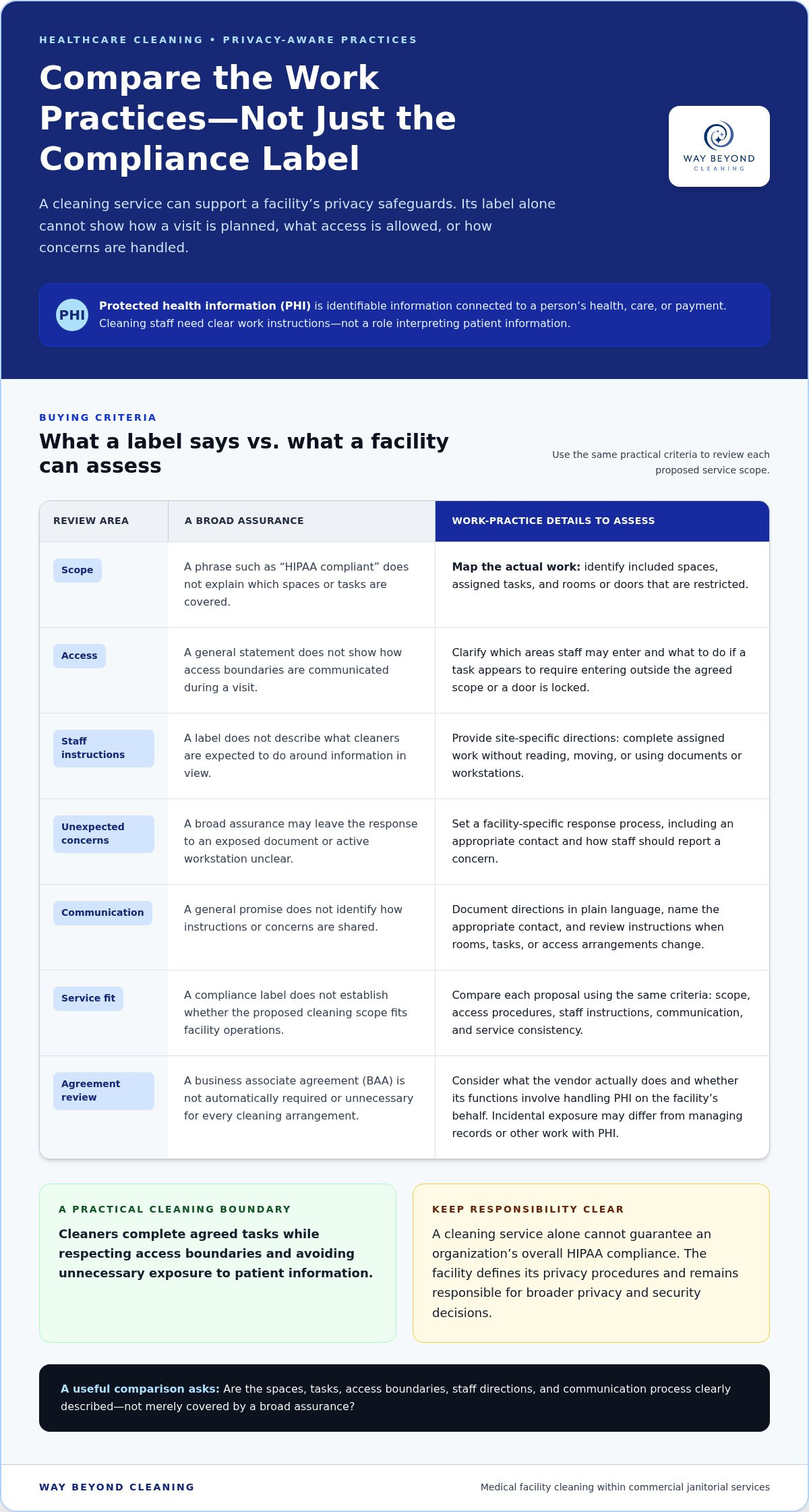
The phrase “HIPAA compliant” may sound reassuring, but a label alone doesn’t explain how a cleaning visit works. Buyers need the practical details: which spaces are included, how access boundaries are communicated, and how staff should raise a concern. Those specifics make it easier to determine whether a service scope fits the facility.
Keep the distinction clear. A cleaning provider’s assigned tasks and access are only one part of a healthcare organization’s broader privacy and security decisions. A vendor’s general statement is not proof of organization-wide compliance, and a cleaning contract does not resolve every privacy question. For a facility-specific interpretation of HIPAA requirements or vendor arrangements, consult qualified legal counsel.
When reviewing HIPAA compliant cleaning services, focus on the working relationship and clearly described practices, not a guarantee a cleaner cannot make on behalf of the whole facility. Way Beyond Cleaning provides medical facility cleaning as part of its commercial janitorial offering in Fairfield County. Review its commercial janitorial services to understand the broader cleaning support available to healthcare buyers.
How HIPAA Privacy Safeguards Relate to Medical Cleaning Work
Privacy-aware cleaning becomes practical when a facility turns its policies into clear directions for people working in its spaces. PHI, or protected health information, means identifiable information connected to a person’s health, care, or payment. Cleaning staff don’t need to interpret that information; they need to understand how the facility expects them to work around it.
Protecting privacy during cleaning means following defined work practices; it doesn’t guarantee an organization’s overall HIPAA compliance. This distinction helps healthcare buyers set an appropriate scope: the cleaning plan can support privacy safeguards, while the organization remains responsible for broader privacy and security decisions.
Staff awareness, access boundaries, and reporting
Useful staff instructions are specific to the site. Before work begins, the facility can explain which areas are included, which are restricted, and what to do if a task appears to require entering a space outside the agreed scope. Instructions should also cover unexpected situations, such as finding sensitive material in a work area or encountering a locked door.
For example, a cleaner who notices a document or active workstation can follow facility directions without reading, moving, or using it. Because the right response depends on the location and the facility’s procedures, instructions should name an appropriate contact and explain how to report concerns. This process is facility-specific; it does not establish a separate legal reporting duty for cleaning staff.
Make expectations easier to follow by documenting them in plain language and reviewing them when rooms, tasks, or access arrangements change. Clear boundaries let staff concentrate on assigned cleaning work instead of making judgment calls about patient information.
When to assess agreements and regulatory guidance
A business associate agreement (BAA) should not be treated as automatically required or automatically unnecessary for every cleaning arrangement. The relevant question is what the vendor actually does and whether its functions involve handling PHI on the facility’s behalf. Incidental exposure during an assigned cleaning task may differ from a role that involves managing records or performing other work with PHI. The details matter.
Healthcare buyers should review the arrangement with their privacy officer or qualified legal counsel, including the work scope, access, and any handling of information. For current interpretations, consult guidance from the U.S. Department of Health and Human Services Office for Civil Rights (HHS OCR), which administers and provides guidance on HIPAA. Revisit authoritative guidance when vendor duties or facility procedures change.
This review gives buyers a more useful basis for discussing HIPAA compliant cleaning services than a label alone: define the work, explain site procedures, and assess the relationship according to its actual functions. It keeps privacy expectations clear without implying that a cleaning provider can certify an entire healthcare organization’s compliance.
How to Compare HIPAA-Aware Medical Cleaning Services in Fairfield County
A useful comparison looks beyond a polished proposal or broad compliance claim. Consider how the planned work fits your facility’s daily rhythm: operating hours, patient flow, room use, and restricted access. A clear scope and communication process make it easier to assess whether cleaning routines support a well-maintained, privacy-conscious environment.
Use the same criteria to review each proposal. Look for specific practices rather than assurances that leave the day-to-day arrangement unclear.
Training and awareness: Does the plan explain how staff receive site-specific instructions about sensitive areas, visible information, and facility procedures?
Access procedures: Are included spaces and restricted areas identified, with directions for locked rooms or access changes?
Communication: Is there a defined way to share schedule updates, access changes, and concerns with facility contacts?
Scope: Are recurring janitorial tasks distinguished from excluded or separately managed work?
Consistency: Does the proposal explain how the facility and cleaning team will keep expectations aligned when room use, schedules, or priorities change?
Compare privacy practices and communication
Useful comparison evidence is concrete. A written description of site orientation, access boundaries, and escalation contacts is more informative than the unsupported phrase “fully compliant.” If a proposal includes documentation, identify what it covers and how it helps the facility understand the agreed work. Don’t assume a provider keeps particular records or follows a specific process unless the proposal says so.
Consider how updates will reach the people who need them. For example, a change to a room’s access status or cleaning schedule needs a clear communication path, rather than relying on informal messages that may not reach assigned staff. Match the proposed routine to your facility’s hours and patient flow so cleaning fits the spaces in use and the timing that works for operations.
Compare cleaning scope with facility needs
Separate recurring janitorial work from specialized clinical procedures. A proposal may cover waiting rooms, offices, and shared spaces, while clinical disinfection or other specialized work follows a distinct facility-defined plan. Specify which rooms are included, what tasks apply in each, and how staff should respond when a room’s use changes. Don’t assume a general medical cleaning description includes every clinical procedure.
This detail helps prevent mismatched expectations. A waiting area used throughout the day may need a different schedule from an administrative office, while a restricted room may require specific access instructions. Define those priorities internally before comparing service scopes.
For broader context on Way Beyond Cleaning’s commercial janitorial services, including medical facility cleaning, review the services in relation to your facility’s operational needs.
A Practical Buying Checklist for Fairfield Healthcare Facilities
A clear buying process starts with your facility, not a generic service description. Map the spaces that need attention, define the work expected in each, review privacy procedures, and assess whether the proposed schedule and scope fit daily operations. This sequence helps Fairfield healthcare teams compare service scopes consistently and identify gaps before they become misunderstandings.
Prepare a facility-specific scope
Create a working outline of spaces, routine tasks, preferred service windows, and access boundaries. Include who can approve changes to room access or schedules and how those changes should be communicated. Keep ordinary janitorial tasks distinct from clinical procedures, which remain governed by the facility’s requirements and qualified personnel.
- Map spaces: Identify waiting areas, administrative offices, shared spaces, and restricted rooms. Note differences in room use and patient flow.
- Define tasks: Specify the routine cleaning expected in each area. Separate those tasks from clinical disinfection or other specialized procedures.
- Set timing and access: Record operating hours, preferred service windows, and boundaries around rooms that require authorization.
- Name communication contacts: Identify who can approve changes and who should receive updates about access, schedule, or scope.
Be precise about infection-control or disinfection expectations. Treat them as separate claims to evaluate, not automatic features of general janitorial work. If a proposal names a disinfectant or describes a particular use, compare that claim with the product’s label and your facility’s applicable procedures. Confirm that the proposed product and use align with the surfaces and purpose described; don’t rely on broad wording alone.
Review proposals without relying on blanket claims
Compare each written scope with your facility’s actual operating requirements. The proposal should identify covered spaces and tasks, explain how schedule or access changes are communicated, and show how privacy concerns are directed to the appropriate facility contact. A general assurance is less useful than a clearly described process your internal team can review.
Walk through each proposal against your space map. Check that timing accounts for patient flow, restricted areas are addressed, and clinical procedures haven’t been blended into routine janitorial tasks. Resolve any unclear responsibility or communication path internally before finalizing the scope. Have your privacy lead or legal counsel review facility-specific interpretations and agreements; a cleaning proposal is not a substitute for that review.
Way Beyond Cleaning provides commercial janitorial services, including medical facility cleaning, in Fairfield County. Review its commercial janitorial services alongside the priorities you have documented for your facility.
Medical Facility Cleaning in Fairfield County: A Clear Next Step
A thoughtful buying process gives healthcare teams a clearer basis for choosing cleaning support: the facility defines its needs, the service scope reflects those needs, and privacy procedures remain part of the organization’s own planning. The goal is a well-maintained setting supported by clear expectations, not a broad promise that a cleaning provider can guarantee overall HIPAA compliance.
What a healthcare facility can expect from a cleaning partner
Medical facility cleaning is a focused part of commercial janitorial work. A useful partnership starts with an agreed scope that identifies the spaces and routine tasks included, along with the facility’s practical priorities. Clarity helps facility leaders understand what the cleaning service covers and where their teams retain responsibility for clinical or privacy-related procedures.
Those boundaries matter. Healthcare organizations set their own access rules, privacy practices, and processes for communicating changes. A cleaning scope supports day-to-day facility upkeep, but it is not a substitute for internal procedures, legal review, or specialized clinical work. For buyers assessing HIPAA compliant cleaning services, keeping these roles distinct helps prevent a service description from being mistaken for a compliance guarantee.
Clear roles also make conversations more productive. Facility leaders can describe which areas need routine cleaning and what operational considerations affect the work. The cleaning partner can then be assessed against a defined commercial scope, rather than assumptions created by a label.
Explore local medical facility cleaning support
Way Beyond Cleaning provides medical facility cleaning as part of its broader commercial janitorial services in Fairfield County, Connecticut. Healthcare facilities can bring the priorities developed during the buying process into a discussion of service scope: the spaces to be maintained, the work being considered, and the facility’s operating needs.
As you plan a cleaning arrangement, keep privacy procedures and internal responsibilities clear while aligning the commercial service scope with day-to-day operations. A clean, orderly setting can contribute to a more welcoming experience for patients and staff, while defined expectations help the facility plan with greater confidence.
Explore medical facility cleaning and commercial janitorial services from Way Beyond Cleaning for your Fairfield County healthcare facility.
Move Forward With a Clear Cleaning Scope
Start with a focused discussion about the environment your facility wants to maintain and the commercial cleaning support that fits its operations. Bring your priorities, including the spaces that need attention and how cleaning should fit around patient care. Clear expectations keep facility needs at the center of the service relationship and help your team plan with confidence.
Choosing HIPAA compliant cleaning services shouldn’t mean relying on a label to resolve every privacy concern. It means setting thoughtful expectations for the cleaning relationship while keeping facility privacy decisions within your organization’s own planning. With a well-defined scope, a cleaning partner can support the day-to-day care of your healthcare environment.
Way Beyond Cleaning provides commercial janitorial services in Fairfield County, including medical facility cleaning. Explore medical facility cleaning services and discuss a cleaning scope for your facility.
Frequently Asked Questions
Are cleaning companies required to sign a HIPAA business associate agreement?
Not in every cleaning arrangement. Whether a business associate agreement (BAA) is appropriate depends on the vendor’s actual functions and relationship with the healthcare organization, not simply its presence in the building. A routine cleaning role may differ from work that involves handling patient records or managing information. Ask your privacy officer or legal counsel to assess the specific arrangement and consult current HHS Office for Civil Rights guidance.
What does HIPAA-aware cleaning mean in a medical office?
It means carrying out assigned cleaning work with awareness of patient privacy and the office’s instructions. For example, a cleaner may be directed to leave papers and devices undisturbed and use only designated routes or rooms. The facility should explain how staff can raise a concern without asking them to interpret clinical information. These work practices can support privacy, but they don’t establish that the whole office meets HIPAA requirements.
Can cleaning staff access areas where protected health information is present?
Access should follow the facility’s own authorization and work plan. A room may contain protected health information without giving everyone who enters permission to view, handle, or use it. Before service begins, the office can distinguish spaces in scope from areas requiring separate approval. If a scheduled task conflicts with a locked door or a changed room status, staff should follow the facility’s designated instructions rather than improvise.
How should a medical facility handle visible patient information during cleaning?
Give cleaning staff a clear site procedure before work starts. It might direct them not to read, move, photograph, or discard visible information, and identify whom to notify if it affects an assigned task. For instance, if paperwork covers a surface that needs cleaning, staff should use the facility’s escalation route rather than move it themselves. The organization should define and communicate the process.
What should healthcare facilities look for in a medical cleaning service?
Look for a service scope that fits the facility’s room types, schedule, and operational priorities, along with a clear way to coordinate changes. Ask how the proposed work distinguishes routine janitorial tasks from procedures managed by clinical staff. If a proposal makes infection-control or disinfection claims, evaluate those separately, including the stated product and intended use. These details provide a grounded basis for assessing HIPAA compliant cleaning services.
Does hiring a cleaning service make a medical practice HIPAA-compliant?
No. Hiring a cleaning service cannot, by itself, establish that a medical practice complies with HIPAA. The practice must consider its broader policies, people, and systems, while defining the cleaner’s role within that environment. Include cleaning arrangements in the practice’s internal privacy review, then direct questions about legal obligations or agreements to its privacy lead or qualified counsel. Keep the vendor’s scope distinct from organization-wide compliance.
How can a Fairfield County medical office compare cleaning service proposals?
Give each proposal the same facility-specific reference: rooms to be serviced, expected tasks, operating constraints, and access limitations. Compare how clearly each document describes what is included, what is outside the scope, and how schedule changes or operational questions will be handled. For Fairfield County offices, consider whether the proposed service fits the facility’s location and working patterns. A consistent comparison makes differences easier to see.


