Your waiting room is spotless. Or so it appears. But if your clinical environment relies on a standard janitorial crew following a generic checklist, what patients and inspectors don't see could be quietly undermining everything you've worked to build. For medical practices across New Haven, the difference between a surface-clean office and a truly compliant, wellness-centered environment is far greater than most realize, and it's a distinction that shapes patient trust, staff wellbeing, and regulatory standing all at once.
You already know that a clinical space demands more than a mop and a spray bottle. The anxiety of an upcoming health inspection, the sting of a patient's hesitant glance at a smudged exam table, the frustration of inconsistent staff who treat your practice like any other office — these aren't small inconveniences. They're real threats to your reputation and your patients' safety. That concern is completely valid, and it's exactly where specialized medical office cleaning in New Haven, CT becomes not just a service, but a strategic necessity.
This article walks you through what a genuine wellness-first approach to clinical cleaning looks like: from OSHA-aligned protocols and documented compliance to the sensory details that transform a medical office into a sanctuary patients feel safe returning to.
Key Takeaways
- Medical office cleaning in New Haven, CT is a specialized discipline governed by OSHA standards and infection control science — not a task any general janitorial crew is equipped to handle.
- Specialized medical facility cleaning plays a measurable role in reducing Healthcare-Associated Infections (HAIs), protecting both patients and staff in ways that standard cleaning simply cannot.
- You'll discover a practical 5-point wellness checklist to evaluate whether your current cleaning vendor is truly meeting the compliance and hygiene demands of a clinical environment.
- New Haven's unique healthcare landscape — from the Yale medical cluster to Long Wharf specialty clinics — creates specific cleaning challenges that require locally informed, wellness-first solutions.
- Learn how partnering with a specialized provider transforms your clinical space into a sanctuary that patients trust, staff feel safe in, and inspectors consistently approve.
Elevating Healthcare Hygiene in New Haven's Medical Corridor
Medical office cleaning isn't a subset of janitorial work. It's an entirely different discipline, one governed by infection control science, regulatory compliance, and an intimate understanding of how pathogens move through clinical environments. A standard cleaning crew armed with a generic checklist simply isn't equipped for it. The protocols, the products, the sequencing of tasks — all of it demands specialized knowledge that goes far beyond what most commercial cleaning services are trained to deliver.
New Haven makes this reality even more pronounced. The city anchors one of the most concentrated healthcare ecosystems in New England, stretching from the Yale School of Medicine and Yale New Haven Health System to the specialty clinics along Long Wharf and the growing network of outpatient practices throughout the region. Patients who walk through these doors are often medically sophisticated, highly attuned to their surroundings, and quick to register the difference between a space that feels genuinely safe and one that merely looks presentable.
The New Haven Healthcare Standard
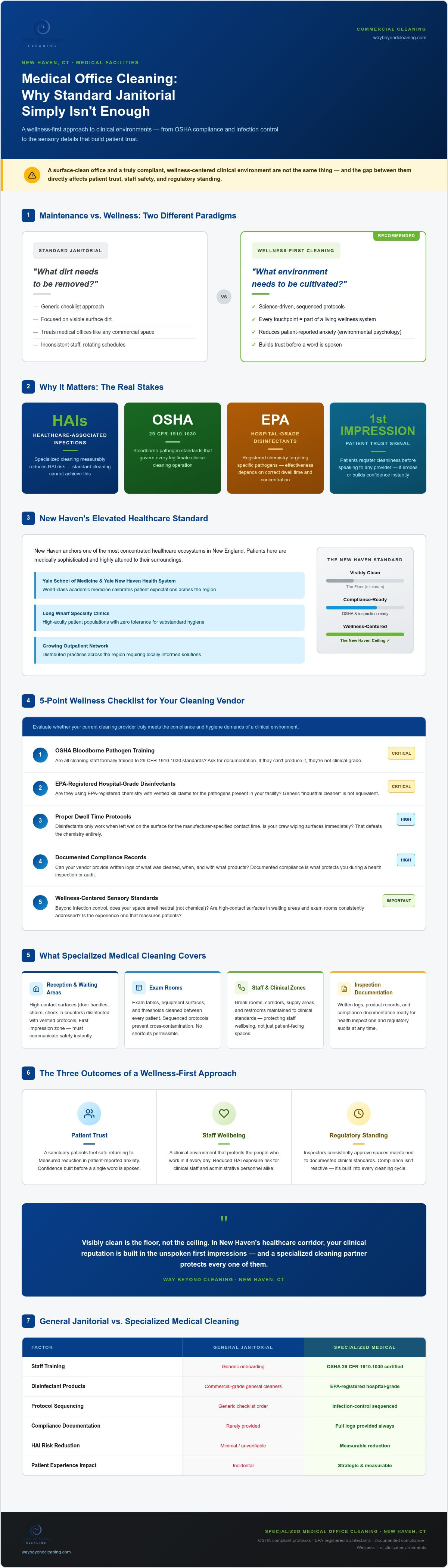
New Haven's patient base doesn't grade on a curve. Proximity to world-class academic medicine has calibrated expectations here. A smudged surface, a faint chemical odor that signals the wrong kind of clean, a waiting room chair with visible wear and residue — these details register. They erode confidence quietly, in the moments before a patient has even spoken to a provider. Effective medical office cleaning in New Haven, CT means meeting a standard where "visibly clean" is the floor, not the ceiling. Your clinical reputation is built in those unspoken first impressions, and a specialized cleaning partner helps protect every one of them.
Wellness vs. Maintenance: A New Paradigm
The most meaningful shift in clinical cleaning isn't technical. It's philosophical. Maintenance asks: What dirt needs to be removed? Wellness asks: What environment needs to be cultivated? These are fundamentally different questions, and they produce fundamentally different results.
When a space is cleaned through a wellness-first lens, it becomes a silent partner in patient care. The air feels lighter. Surfaces carry no residual harshness. The sensory experience — the visual clarity, the neutral scent, the absence of anything that signals neglect — communicates competence before a single word is exchanged. Research in environmental psychology consistently links clean, ordered clinical spaces to measurable reductions in patient-reported anxiety. That's not a soft benefit. It's a clinical one.
Way Beyond Cleaning approaches medical office cleaning in New Haven, CT with exactly this orientation. Every touchpoint, from high-contact reception surfaces to exam room thresholds, is treated as part of a living wellness system, not a task on a rotating schedule. Explore the full scope of WBC's medical facility cleaning services to understand what a truly wellness-centered approach looks like in practice.
The Science of Sanctuary: Clinical Standards & Infection Control
Clean isn't a feeling. It's a measurable outcome, one governed by specific standards, verified sequences, and rigorously tested chemistry. Where general cleaning services operate on intuition and habit, true clinical cleaning operates on science. And the gap between those two approaches is exactly where patient safety either holds or breaks down.
OSHA's bloodborne pathogen standards (29 CFR 1910.1030) establish the baseline for any legitimate clinical cleaning operation. These aren't suggestions. They define how staff must be trained, how contaminated materials must be handled, and how surfaces in contact with potentially infectious material must be treated. Compliance isn't optional; it's the foundation on which every other cleaning decision is built.
Equally critical is the chemistry itself. EPA-registered, hospital-grade disinfectants are formulated to eliminate specific pathogens at verified concentrations, but their effectiveness depends entirely on dwell time, the period a disinfectant must remain wet on a surface to achieve its rated kill claims. Wiping a surface dry before that window closes doesn't just reduce efficacy; it creates a false sense of security that's arguably more dangerous than no disinfection at all.
Sequencing matters just as much as chemistry. CDC-aligned cleaning protocols follow a strict logic: clean to dirty, top to bottom. This isn't procedural preference. It's pathogen physics. Contaminated particles fall. Cleaning against that flow redistributes what you're trying to eliminate. Disciplined sequencing ensures that every surface encountered later in the process is addressed with a clean tool, not one carrying residue from a previous zone.
Color-coded microfiber systems reinforce that logic at the equipment level. Assigning specific cloth colors to specific zones, exam rooms, restrooms, reception, and clinical prep areas, physically prevents cross-contamination between spaces. It transforms what could be an invisible error into a visible, preventable one.
By 2026 industry standards, terminal cleaning in a medical office context refers to a comprehensive, documented disinfection process applied to an entire clinical space following a high-risk patient encounter or at the close of an operational period, designed to reduce the microbial burden on all surfaces to a safe baseline before the next patient interaction.
Compliance-Ready Cleaning Protocols
Inspection readiness isn't something you scramble for. It's something you build into every cleaning cycle. That means Safety Data Sheets (SDS) are current, accessible, and organized at all times. Chemical labeling follows OSHA's Hazard Communication Standard without exception. Staff understand the clinical distinction between disinfection, which reduces pathogens to safe levels, and sterilization, which eliminates all microbial life, and they apply that knowledge correctly based on surface type and risk classification.
Documentation closes the loop. Cleaning logs, product application records, and verification checklists create an auditable trail that transforms invisible labor into visible accountability. For practice administrators, that paper trail isn't bureaucratic overhead; it's evidence that your clinical environment is managed with the same rigor you bring to patient care.
Eco-Friendly Clinical Excellence
High-level disinfection and ecological responsibility aren't competing priorities. They're complementary ones, when approached with precision. Way Beyond Cleaning's wellness-first orientation toward medical office cleaning in New Haven, CT means selecting EPA-registered products that deliver proven pathogen reduction without flooding clinical air with volatile organic compounds (VOCs) that compromise indoor air quality.
Indoor air quality matters acutely in medical environments. Patients with respiratory conditions, compromised immune systems, or chemical sensitivities are disproportionately harmed by harsh cleaning residues that linger long after the cleaning crew has left. Choosing low-VOC, sustainably formulated disinfectants protects those patients in ways that standard chemical protocols simply don't account for.
Ecological responsibility in a clinical context isn't a marketing position. It's a patient wellness decision. When the air in your waiting room is genuinely clean rather than masked by synthetic fragrance, when surfaces carry no chemical harshness that patients with sensitive skin register on contact, the sensory experience shifts. The space communicates care before a single clinical interaction begins. Learn how WBC's medical facility cleaning services integrate compliance and sustainability into a single, seamless protocol.
Beyond Janitorial: Why Medical Facilities Require Specialized Care
Consider what a corporate office actually demands from its cleaning crew: emptied wastebaskets, vacuumed carpets, wiped desks, sanitized restrooms. The stakes, while real, are bounded. Now consider what your medical waiting room demands every single day: surfaces that have been in contact with symptomatic patients, immunocompromised individuals, and a rotating cast of health conditions your cleaning team will never be formally briefed on. The environments look similar. The risks are not remotely comparable.
This is the core distinction that separates specialized medical facility cleaning from standard janitorial service. It's not about effort or frequency; it's about training and protocol literacy. Specialized providers like BioClean & Hygiene Services exemplify this approach, bringing the clinical awareness necessary to transform a cleaning technician into a genuine guardian of patient safety.
Waiting Rooms: The Patient First Impression
Your waiting room is a high-contact ecosystem. Every kiosk touchscreen, every reception counter edge, every glass partition that patients press close to while checking in, these surfaces accumulate microbial load at a rate that standard cleaning schedules aren't designed to address. Effective medical office cleaning in New Haven, CT treats these surfaces as priority zones, not afterthoughts, applying EPA-registered disinfectants with verified dwell times rather than a quick wipe that creates the appearance of cleanliness without delivering it.
High-traffic floors present their own challenge. The goal isn't just clean; it's safe and visually calm. Wet floor hazards, streaked surfaces, and harsh chemical odors all signal disorder to a patient who's already anxious. A wellness-first approach manages flooring with products and techniques that leave surfaces dry, residue-free, and visually clear, contributing to the sensory atmosphere that tells patients, before a single word is spoken, that they're in capable hands.
Exam & Procedure Room Integrity
Exam rooms require a different discipline entirely. Terminal cleaning protocols here address every surface in a defined sequence: exam tables, sink fixtures, counter edges, equipment housings, and door hardware, all treated with the precision that high-risk patient contact demands. Biohazard bin handling follows specific protocols aligned with Connecticut Department of Energy and Environmental Protection guidelines, ensuring that regulated medical waste is managed correctly at the point of collection, not just at disposal.
High-throughput procedure rooms are particularly vulnerable to the "good enough" trap, where speed overrides thoroughness between patient visits. The sanctuary feel of a clean exam room isn't a luxury detail. It's a clinical signal that patients read instantly and remember long after they've left.
One objection surfaces consistently: the cost premium of specialized medical cleaning over standard janitorial service. The honest answer is that the comparison is false. A Healthcare-Associated Infection traced back to an inadequately cleaned surface carries costs, in patient harm, liability exposure, and reputational damage, that dwarf any cleaning budget differential. HIPAA-aware cleaning staff add another layer of value that standard crews simply don't provide; they understand how to work around patient records, sensitive conversations, and clinical workflows without compromising privacy or disrupting care.
Way Beyond Cleaning brings this full spectrum of specialized capability to medical office cleaning in New Haven, CT. Explore WBC's medical facility cleaning services to see how a truly clinical approach differs from what a general janitorial contract delivers.
A Practice Manager's Guide to Sustaining Clinical Excellence
Knowing that your clinical environment demands specialized care is one thing. Actively managing it between service visits, evaluating whether your current vendor is truly delivering, and building the internal habits that protect your practice day to day — that's the operational work that most guides skip entirely. This section addresses exactly that gap.
Start with an honest assessment of your current cleaning partner. Not every vendor who claims medical experience actually has it. These five questions cut through the noise quickly:
- Can they produce current Safety Data Sheets for every product used in your facility? If there's any hesitation, that's your answer.
- Are staff trained specifically in OSHA bloodborne pathogen standards? General cleaning certifications don't qualify.
- Do they use color-coded microfiber systems? If they can't explain why, cross-contamination between zones is likely happening.
- Is there a documented cleaning log you can review after each visit? Invisible labor without accountability is a liability, not a service.
- Do they understand the clinical distinction between disinfection and sterilization? The wrong answer in the wrong room puts patients at risk.
Communication is the other variable that separates adequate vendors from genuine partners. Your cleaning provider should have a clear, responsive channel for flagging protocol changes, reporting concerns, and adjusting schedules around clinical workflows. A vendor who's difficult to reach between visits isn't managing your environment; they're servicing a contract. That distinction matters acutely in medical office cleaning in New Haven, CT, where patient volume and seasonal illness patterns can shift hygiene demands significantly from week to week.
Daily Maintenance Best Practices
Professional cleaning cycles alone can't carry the full load in a high-traffic clinical setting. Staff play a meaningful role in maintaining the environment between visits. Designate clear ownership of high-touch point management during operating hours: reception desks, kiosk screens, door handles, and shared pens should be wiped with an appropriate disinfectant at defined intervals, not just when something looks visibly soiled. Spills require immediate attention and a documented response, not a mental note for the evening crew. Learn more about our comprehensive commercial services to understand how professional protocols and daily staff habits work in tandem.
Choosing the Right New Haven Partner
During any RFP process, verify insurance and bonding documentation directly, don't accept verbal assurances. Ask specifically about HIPAA-aware staff training and whether technicians are briefed on clinical workflow protocols before their first visit. High-volume New Haven clinics should also ask about day porter availability, dedicated on-site support during operating hours that addresses real-time hygiene needs rather than waiting for the next scheduled clean. It's a practical investment that protects the patient experience at its most vulnerable moments. Explore the Wellness-First Approach to Medical Facility Cleaning to see how these principles translate across Connecticut's clinical landscape.
The right partner doesn't just clean your practice. They protect it. Connect with Way Beyond Cleaning to evaluate what a truly specialized medical facility cleaning partnership looks like for your New Haven practice.
Way Beyond Cleaning: Your Wellness Partner in New Haven Healthcare
There's a meaningful difference between a vendor who cleans your clinic and a partner who protects it. Most medical cleaning services operate in the first category: they show up, they work through a checklist, and they leave. Way Beyond Cleaning was built around a different premise entirely. Every clinical space we care for is treated as a sanctuary in progress, an environment where the quality of the air, the integrity of the surfaces, and the sensory experience of every room contribute directly to patient wellbeing and practice reputation.
For practice managers across New Haven County and the shoreline medical belt, that distinction translates into something tangible: fewer compliance concerns, fewer patient-experience gaps, and significantly less mental overhead spent wondering whether your cleaning vendor is actually doing what you're paying them to do.
A Trusted Guardian of Your Clinic
Our staff aren't trained as cleaners who happen to work in medical environments. They're trained as health-and-home partners who understand the clinical weight of their work. That means OSHA bloodborne pathogen protocols aren't a box they check; they're a professional standard they internalize. It means they understand why dwell time matters, why sequencing is non-negotiable, and why a color-coded microfiber system protects your patients in ways that a single shared cloth never could.
The service experience itself reflects that same philosophy. We move between authority and empathy with intention: clear, accountable protocols that give you confidence in the outcome, paired with a genuine responsiveness to the specific rhythms of your practice. Your clinic isn't a template. We don't treat it like one. Discover our commitment to quality and wellness and understand what it means to work with a partner who takes the guardian role seriously.
Seamless Transitions and Reliable Results
Clinical chaos is often invisible. It lives in the gap between what your current vendor promises and what your patients actually experience. Transitioning to a specialized recurring janitorial contract with Way Beyond Cleaning closes that gap systematically: customized service schedules built around your patient volume, documented cleaning logs that create real accountability, and a communication channel that stays open between visits rather than going quiet until the next appointment.
The long-term return on that investment is real. A clinical environment that consistently communicates cleanliness, order, and care retains patients, earns referrals, and passes inspections without scrambling. That's not a soft benefit. It's a measurable business outcome rooted in a decision you make about who manages your space.
For medical office cleaning in New Haven, CT that goes beyond surface-level service, Way Beyond Cleaning is ready to build something tailored specifically to your practice. Request your personalized New Haven medical cleaning quote and take the first step toward a clinical environment your patients feel before they say a word.
Your Clinical Environment Deserves More Than a Checklist
Every detail covered in this guide points toward the same truth: medical office cleaning in New Haven, CT isn't a commodity service you can hand off to the lowest bidder and forget. It's a clinical decision with real consequences for patient safety, regulatory standing, and the quiet confidence your practice communicates before a single word is spoken.
The practices that get this right share three commitments. They insist on OSHA and CDC compliant protocols, not as a compliance exercise, but as a genuine standard of care. They invest in specialized healthcare training that transforms cleaning technicians into informed guardians of patient wellbeing. And they choose partners who bring a wellness-focused sanctuary approach to every room, every surface, every visit.
Your patients notice. Your staff notices. Inspectors notice. The question isn't whether your environment communicates something; it's whether it communicates what you intend.
You've built something worth protecting. Take the next step and let a partner who understands clinical environments protect it with you. Elevate your clinic to a wellness sanctuary and get a New Haven medical cleaning quote today.
Frequently Asked Questions About Medical Office Cleaning in New Haven, CT
What is the difference between standard office cleaning and medical office cleaning in New Haven?
Standard office cleaning addresses visible soil: emptied bins, vacuumed floors, wiped desks. Medical office cleaning operates on an entirely different level, governed by infection control science, OSHA bloodborne pathogen standards, and pathogen-specific chemistry with verified dwell times. The surfaces, the risks, and the consequences of an inadequate clean are simply not comparable between a corporate office and a clinical environment.
In New Haven specifically, the patient population is medically sophisticated and attuned to environmental cues. A clinical space that's merely tidy won't meet that standard. Specialized medical office cleaning in New Haven, CT means treating every high-contact surface as a potential transmission point, not just a smudge to remove.
Are your cleaning crews trained in OSHA bloodborne pathogen standards?
Yes. Way Beyond Cleaning staff are trained in OSHA's bloodborne pathogen standards (29 CFR 1910.1030), which govern how potentially infectious materials are handled, how contaminated surfaces are treated, and what personal protective equipment is required. This isn't a general cleaning certification; it's clinical-specific training that shapes every decision a technician makes inside your facility.
That training is also ongoing, not a one-time orientation. Protocols evolve, and staff need to reflect those changes consistently. When you work with a specialized provider, that training accountability is built into the partnership, not left to chance.
How do you ensure HIPAA compliance and patient privacy during cleaning?
HIPAA-aware cleaning means staff understand how to work around patient records, sensitive conversations, and clinical workflows without compromising privacy. Technicians are briefed on what they may encounter in a clinical environment and trained not to interact with, photograph, or disturb any patient-identifiable materials. They move through your space with discretion and a clear awareness of their role within a healthcare setting.
Practically, this also means coordinating cleaning schedules around patient flow, ensuring that exam rooms and administrative areas aren't accessed during active consultations, and maintaining the kind of professional conduct that protects your practice's compliance posture at every visit.
What types of disinfectants do you use for New Haven medical facilities?
Way Beyond Cleaning uses EPA-registered, hospital-grade disinfectants selected for their verified efficacy against specific pathogens relevant to clinical environments. Product selection also prioritizes low VOC formulations, which protect patients with respiratory conditions, chemical sensitivities, or compromised immune systems from residual chemical exposure after the cleaning crew has left.
Every product used in your facility is supported by a current Safety Data Sheet, accessible and organized for immediate review. If you're evaluating a cleaning partner, the ability to produce those SDS documents without hesitation is a baseline requirement, not a bonus.
Can you provide medical cleaning services for specialty clinics like dental or oncology?
Yes. Way Beyond Cleaning's medical facility cleaning services extend to specialty clinical environments, including dental practices and oncology clinics, where infection control demands are particularly acute. Dental operatories involve aerosol-generating procedures that elevate surface contamination risk. Oncology settings serve immunocompromised patients for whom any lapse in disinfection protocol carries serious consequences.
Each specialty environment receives a customized cleaning protocol rather than a generic checklist. The sequencing, the product selection, and the attention to specific high-risk zones are all calibrated to the clinical reality of that particular practice type.
How do you handle biohazard bin disinfection and waste protocols?
Biohazard bin handling follows protocols aligned with Connecticut Department of Energy and Environmental Protection guidelines, addressing regulated medical waste at the point of collection. This means bins are managed with appropriate PPE, never overfilled, and treated as contaminated surfaces requiring disinfection at the exterior before and after liner replacement.
It's important to note that Way Beyond Cleaning provides medical facility cleaning services; biohazard remediation is a separate, licensed discipline. What we deliver is rigorous protocol around the routine management of biohazard receptacles within your clinical space, ensuring that daily waste handling doesn't become an infection control gap.
What is included in a terminal clean for a New Haven procedure room?
A terminal clean is a comprehensive, documented disinfection process applied to an entire clinical space, designed to reduce microbial burden on all surfaces to a safe baseline before the next patient interaction. For a procedure room, this includes exam tables, sink fixtures, counter edges, equipment housings, door hardware, light switches, and flooring, all addressed in a strict clean-to-dirty, top-to-bottom sequence using EPA-registered disinfectants applied with verified dwell times.
Documentation is integral to the process. A completed cleaning log after every terminal clean creates an auditable record that supports your compliance posture and gives practice administrators concrete evidence that the work was done correctly, not just completed.
How often should a medical office in New Haven be professionally deep cleaned?
The right frequency depends on patient volume, the nature of procedures performed, and the specific zones within your practice. High-throughput primary care offices typically require more frequent deep cleaning cycles than lower-volume specialty practices. At minimum, exam and procedure rooms should receive thorough terminal cleaning at the close of every operational day, with high-contact waiting room surfaces addressed on an intra-day schedule during peak hours.
A specialized cleaning partner will assess your specific practice rhythms and recommend a schedule built around your clinical reality rather than a generic rotation. That customization is one of the clearest distinctions between a true medical cleaning partner and a standard janitorial contract.


