

What if the best condo cleaning plan isn’t the one with the most visits, but the one with the clearest scope? For a board considering condo association cleaning Norwalk CT, it can be difficult to separate shared-space responsibilities from work inside individual units, then match cleaning frequency to how residents use the building. A vague plan can leave expectations unsettled and results inconsistent.
Residents want common areas to feel fresh, orderly, and cared for. Boards, in turn, need a practical plan for maintaining association-managed spaces. Clear priorities can help bring these goals together while keeping the service scope easy to explain.
This guide lays out how to identify shared spaces, describe the cleaning attention they need, and weigh the factors that shape a recurring schedule. You’ll also see how square footage and visit frequency can inform a customized janitorial plan. With a written scope and clear priorities, a Norwalk board can make a more informed decision and set consistent expectations for residents.
Key Takeaways
- Define which association-managed shared spaces belong in the cleaning plan, keeping the scope distinct from individual units.
- Use resident traffic, shared use, and presentation needs to set cleaning priorities across the property.
- Compare scope, property area, visit frequency, and association priorities to assess recurring plans.
- Build a board-ready process by mapping spaces, ranking needs, setting frequency, and documenting expectations with resident and property-management input.
- A clear plan for condo association cleaning Norwalk CT can support a more consistent, cared-for environment, with service planning tailored to square footage and visit frequency.
Condo Association Cleaning in Norwalk, CT: What Should the Board Plan For?
Before choosing a recurring cleaning schedule, define what the association wants cleaned. Start with shared spaces, then shape the service scope around the property’s layout, how residents use it, and the association’s responsibilities. This gives the board a practical basis for setting expectations and discussing how shared areas should look and feel day to day.
Condo association cleaning focuses on association-managed common areas, not the interiors of individual private units. Keeping that distinction clear helps the board plan for shared property without blurring responsibilities. In Norwalk and elsewhere in Fairfield County, the right scope depends on the building’s layout and the spaces the association manages.
Which spaces belong in an association cleaning plan?
Walk through the property and identify the places residents use together. Depending on the layout and the association’s responsibilities, these may include:
- Building entrances and lobbies
- Interior hallways and shared stairwells
- Shared lounges or other common rooms
- Other association-managed spaces residents regularly access
Use the list as a starting point, not a universal checklist. A space belongs in the plan because it is shared and association-managed, not simply because it is inside the building. Residents’ private kitchens, bathrooms, and living spaces remain separate from common-area priorities. For general background on how an association functions, boards can consult this overview of a homeowner association.
Why does a defined scope matter to a condo board?
A clear scope turns a broad expectation such as “keep the building clean” into a shared understanding of which areas are included and what attention they need. Without that clarity, residents may assume a task is covered while decision-makers believe it falls outside the plan. The mismatch can lead to uneven expectations and less productive service discussions.
A condo association cleaning scope is a written description of the association-managed spaces included in recurring service and the cleaning attention each space is intended to receive.
This definition gives board members a steady reference point as they consider service priorities and resident feedback. A clean, orderly entrance supports a positive first impression, while regular attention to hallways and shared rooms helps keep these spaces welcoming. A well-defined plan also makes expectations easier to communicate and recurring care easier to assess. It gives the board a clearer foundation for deciding what to address next.
Norwalk Condo Cleaning Scope: Match Shared Spaces to Their Needs
Once the board has identified its common areas, consider how residents use them. A condo association cleaning Norwalk CT plan should reflect the property’s actual routines rather than assume every shared space needs the same attention. Walk through the building, note where residents regularly pass or gather, and use resident and property-management feedback to rank priorities.
How can a board prioritize high-use common areas?
Entrances and corridors often shape first impressions and see regular foot traffic. Shared lounges and other facilities may also need attention based on how often residents use them. Consider the building’s daily patterns and any feedback about spaces that feel less orderly or welcoming. The CDC guidelines for cleaning community spaces can offer broader context for thinking about shared environments and commonly touched surfaces.
| Shared space | Planning prompt | Priority to consider |
|---|---|---|
| Entrance or lobby | How often do residents and visitors pass through? | Visible presentation and regular upkeep |
| Hallways or corridors | Do residents use these routes throughout the day? | Consistent attention to a frequently shared area |
| Shared lounge or facility | How often, and by whom, is the space used? | Care that reflects shared use and resident expectations |
Use the table to guide the discussion, not as a fixed schedule. Building layouts, resident routines, and association priorities vary. Base the service frequency on the board’s observations of its own property rather than applying the same schedule to every Norwalk condo community.
How should the association describe its cleaning expectations?
Write expectations in plain language. List each included space, its general priority, and the desired visit frequency. Separate routine upkeep from occasional, more intensive needs. This distinction helps prevent residents from assuming every periodic task is part of every recurring visit.
For example, the board might note that an entrance needs regular attention, while a less-used shared room has different priorities. Describe the desired result and the areas included so the scope is easy to interpret. For broader commercial-service context, see this guide to commercial janitorial services in Fairfield.
Clear notes make board conversations more focused and help translate resident expectations into a practical plan. Way Beyond Cleaning provides commercial janitorial services with recurring plans customized by property square footage and visit frequency, making it possible to tailor service to a condo association’s shared spaces.
How to Evaluate a Recurring Condo Cleaning Plan in Norwalk
A recurring plan should connect the property’s size and shared-space priorities with a visit frequency the association can sustain. When evaluating condo association cleaning Norwalk CT, consider these factors together so the board can compare plans by fit, not by a single headline figure. Square footage and visit frequency inform customized recurring commercial janitorial agreements, while the included spaces and the association’s priorities define what the service is intended to address.
Which factors shape a recurring service agreement?
Consider how much of the property falls within the scope, which areas the association wants included, and how often the building needs service. A larger area or a different visit frequency can shape the plan, but neither factor tells the whole story. The board’s ranked priorities help connect these details to the spaces residents share and the level of recurring attention the association wants.
Use a comparison table to assess plans against the same criteria:
| Scope | Property area | Visit frequency | Association priority |
|---|---|---|---|
| Spaces included in the recurring plan | Square footage covered by the scope | Visits planned for the recurring service | Highest-ranked shared-space needs |
| Additional shared areas under consideration | Relevant area of the property | Frequency aligned with intended upkeep | Secondary or less-used priorities |
Fill in the table using the association’s property information and desired plan. It can help the board spot whether the scope, area, and frequency align, or whether priorities need refining before making a decision.
How can the board assess value without focusing only on price?
Value starts with clarity. Compare the proposed scope with the spaces the board identified, then consider whether the visit frequency fits the property’s recurring needs. A plan that is easy to understand and aligned with the association’s priorities gives board members a stronger basis for discussion than a vague description.
Way Beyond Cleaning tailors recurring commercial janitorial agreements by square footage and visit frequency. This helps an association consider the area being cared for alongside the routine it wants to establish, rather than assume every property needs the same arrangement. Explore commercial cleaning services to learn more about the service approach.
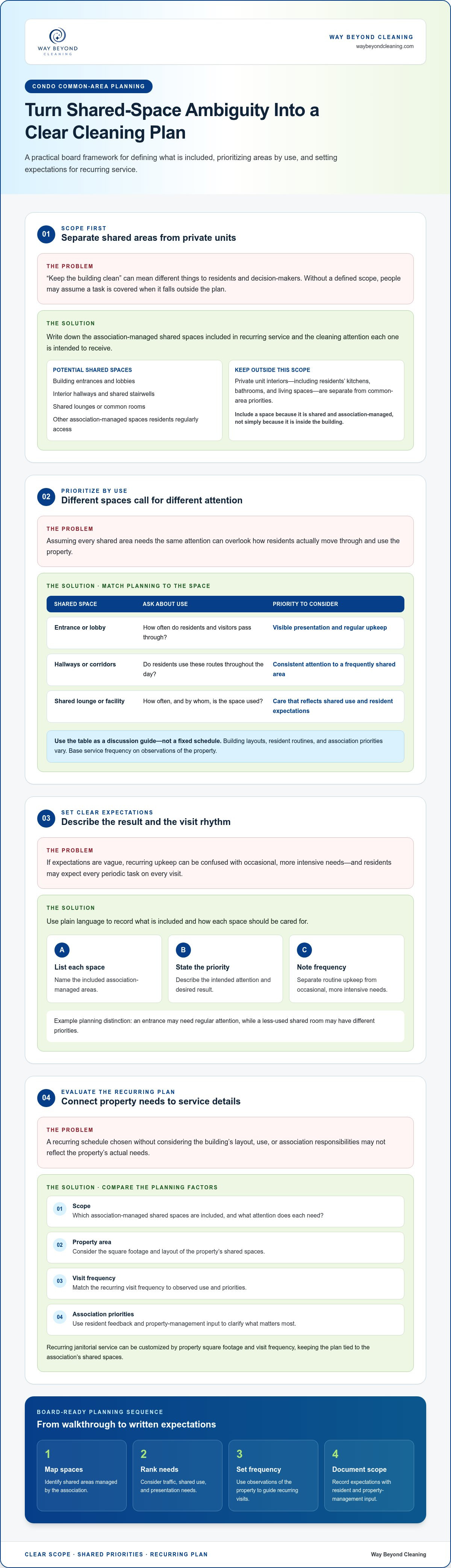
A Board-Ready Process for Planning Condo Association Cleaning in Norwalk
A practical cleaning plan is easier to discuss when the board can point to specific spaces, priorities, and a preferred routine. For condo association cleaning Norwalk CT, a short written brief can turn resident feedback into clear direction for recurring service, without blurring shared-area needs with cleaning inside individual units.
What information should the board gather first?
Start with a property walkthrough and input from residents and property management. Record association-managed areas, how residents use them, and any recurring concerns. Rank the spaces according to shared use and the attention the association wants them to receive. Keep the notes focused on common areas rather than private-unit requests.
- Map the spaces: List the entrances, corridors, shared rooms, and other association-managed areas.
- Rank priorities: Note which spaces matter most for everyday use and visible presentation.
- Set a preferred frequency: Describe the routine the association wants for the identified scope.
- Capture recurring concerns: Summarize relevant resident and property-management feedback.
Different shared facilities can call for different priorities. A frequently used lounge, for example, may have different considerations from a building entrance. For broader context on how cleaning approaches can vary by facility, see this specialty cleaning guidance for Fairfield businesses.
How can the board communicate the plan clearly?
Bring the findings together in a concise brief that names the areas, their general priorities, and the preferred visit frequency. Use plain, consistent descriptions so board members and the janitorial team can interpret the scope in the same way. Avoid broad phrases such as “clean all common areas” unless the association has clearly identified what that includes.
A useful brief separates the regular service scope from periodic needs, records why the highest priorities matter, and leaves room to revisit the plan if resident use or expectations change. It does not need to be elaborate. Its purpose is to give the board a shared reference for productive discussion and a clear starting point for planning recurring care.
Way Beyond Cleaning tailors recurring commercial janitorial agreements to square footage and visit frequency. Explore commercial janitorial services to see how a defined scope can support a consistently cared-for shared environment.
Choose a Norwalk Condo Cleaning Partner for a More Assured Routine
A thoughtfully planned recurring service can help shared spaces feel more orderly and cared for, while giving residents and board members clearer expectations. The foundation is the work the association has already done: identify the common areas, rank their needs, and describe the preferred routine in writing. That documented scope gives the service relationship a practical starting point without assuming every property needs the same approach.
What makes a cleaning relationship easier to manage?
Clarity makes coordination simpler. When the association and janitorial team share an understanding of the included areas, the priorities, and the desired visit frequency, conversations have a consistent reference point. Residents can better understand the plan, and the board can revisit it as shared-space needs change. A recurring structure supports ongoing care while keeping expectations grounded in the association’s documented priorities.
Way Beyond Cleaning’s commercial janitorial agreements can be tailored to a property’s square footage and desired visit frequency. This connects the size of the area being serviced with the routine the association is planning, rather than relying on a one-size-fits-all schedule. For boards considering condo association cleaning Norwalk CT, a clear scope keeps the focus on shared spaces and the association’s priorities.
What is the next step for a Norwalk association?
Prepare a concise space list, note the priorities for each area, and outline the visit frequency the board wants to consider. These details can guide a focused discussion about a recurring plan. Way Beyond Cleaning is based in Fairfield, Connecticut, and serves Fairfield County, making it a local option for Norwalk associations planning commercial janitorial service.
A more assured routine begins with a clear conversation about the property’s needs. Explore Way Beyond Cleaning’s commercial services and take the next step toward a cleaning approach shaped around your association’s shared spaces, square footage, and preferred frequency.
Set a Clear Routine for Your Shared Spaces
A thoughtful plan starts by separating association-managed common areas from individual units, then matching the scope and visit frequency to how residents use those spaces. A written list of priorities gives the board a clear basis for discussing condo association cleaning Norwalk CT and setting expectations for recurring care.
Way Beyond Cleaning serves Fairfield County with recurring commercial janitorial agreements customized by square footage and visit frequency. Associations can use those factors to shape an approach around the property and its documented needs instead of relying on a one-size-fits-all routine.
With the shared spaces mapped and priorities in view, your board can take a confident next step. Explore a tailored cleaning approach for your association and move toward a more consistently cared-for environment for residents.
Frequently Asked Questions
What does condo association cleaning typically cover?
Condo association cleaning generally focuses on association-managed shared spaces, rather than residents’ private units. Depending on the property, the scope might include entrances, lobbies, hallways, shared lounges, or other common areas. The board can identify which spaces belong in its plan and describe their priorities clearly. A property-specific scope helps residents understand what recurring service is intended to cover.
How often should a condo association schedule common-area cleaning?
The right frequency depends on the building’s layout, how residents use shared spaces, and the association’s priorities. An entrance or busy corridor may call for a different routine than a less-used shared room. Gather resident and property-management input, then consider how often each area needs attention. There’s no single schedule for every Fairfield County property, so base the plan on the association’s documented needs.
How can a condo board define a clear cleaning scope?
A board can define a clear scope by listing the association-managed spaces, noting each area’s general priority, and recording the preferred visit frequency. Use plain descriptions that distinguish recurring upkeep from occasional needs. Keep the scope focused on common areas, not individual-unit cleaning. A written plan gives board members and the cleaning team a shared reference and helps prevent different assumptions about which spaces recurring service addresses.
What affects the cost of recurring condo association cleaning?
Recurring service planning can take into account the square footage included, the shared areas in scope, and the desired visit frequency. These factors help shape an agreement around the property’s needs. To assess value, first document the spaces and priorities, then compare them with the proposed scope. Way Beyond Cleaning customizes recurring commercial janitorial agreements by square footage and visit frequency, so associations can consider a plan around their property.
Can a commercial janitorial plan be tailored to a condo building?
Yes. A recurring commercial janitorial agreement can be tailored to a condo building’s square footage and desired visit frequency. The association can identify the common areas it wants addressed and clarify their priorities, then use that information to shape a recurring scope. For boards planning condo association cleaning Norwalk CT, this approach connects shared-space needs with a clear service routine in Fairfield County.
How should a condo association compare cleaning plans?
Compare plans using the same criteria: spaces included, property area covered, visit frequency, and the association’s priorities. Look for a clear description of the proposed scope and consider whether the routine reflects how residents use shared areas. This makes the discussion more useful than comparing a single figure without context. A plan aligned with documented needs is easier for the board to explain and evaluate.
Does condo association cleaning include individual units?
Condo association cleaning is generally planned for association-managed common areas, not the interiors of individual private units. A board can list spaces such as shared entrances, corridors, or lounges as appropriate to its property, while keeping residents’ personal rooms separate from the common-area plan. Defining this boundary in writing helps residents understand what recurring association service is designed to address and keeps the scope focused.


