

Effective post-pandemic office cleaning standards focus on consistent routine cleaning, with targeted disinfection when circumstances call for it. Using more disinfectant does not automatically make an office healthier, and treating every surface as an ongoing infection risk can make routines harder to manage.
It’s understandable to be unsure which pandemic-era practices still make sense. Employees want shared spaces to feel cared for, while office managers need routines that are clear, proportionate, and easy to check. Current CDC guidance for non-healthcare settings emphasizes regular cleaning of high-touch surfaces and reserving disinfection for situations where it’s needed.
This 2026 guide turns broad hygiene goals into practical standards for your workplace. You’ll learn how cleaning differs from disinfection, which shared areas need routine attention, and how to set expectations for visible, accountable service. You’ll also find ways to assess professional janitorial support, including whether the scope and visit frequency fit your office. The aim is a dependable approach that supports employee confidence without relying on outdated assumptions.
Key Takeaways
- Build post-pandemic office cleaning standards around repeatable tasks that reflect how your workplace is used.
- Set clear expectations for surfaces, shared areas, restrooms, and waste, adjusting routines to observed conditions and workplace needs.
- Distinguish routine cleaning from disinfection so each is used for the right purpose.
- Make expectations actionable by mapping office spaces, current tasks, and who is responsible for each one.
- When comparing janitorial support in Fairfield County, ask how providers define service scope, visit frequency, communication, and site-specific needs.
Post-Pandemic Office Cleaning Standards: What Has Changed?
Workplace expectations have evolved. Employees and managers may still value visible attention to shared spaces, but a practical standard today isn’t a blanket demand to disinfect every surface. It’s a documented, repeatable cleaning approach that reflects how an office is used, with tasks and responsibilities that can be reviewed as needs change.
This shift makes standards easier to apply. Rather than continuing pandemic-era habits without checking whether they remain useful, offices can maintain routine cleaning and reserve disinfection for appropriate situations.
Which pandemic-era cleaning habits still matter?
Regular care for frequently used shared areas remains practical. Include surfaces such as shared desks, door handles, meeting-room tables, and breakroom counters in the cleaning plan. Set tasks and frequency according to how the office operates instead of assuming one schedule will suit every workplace.
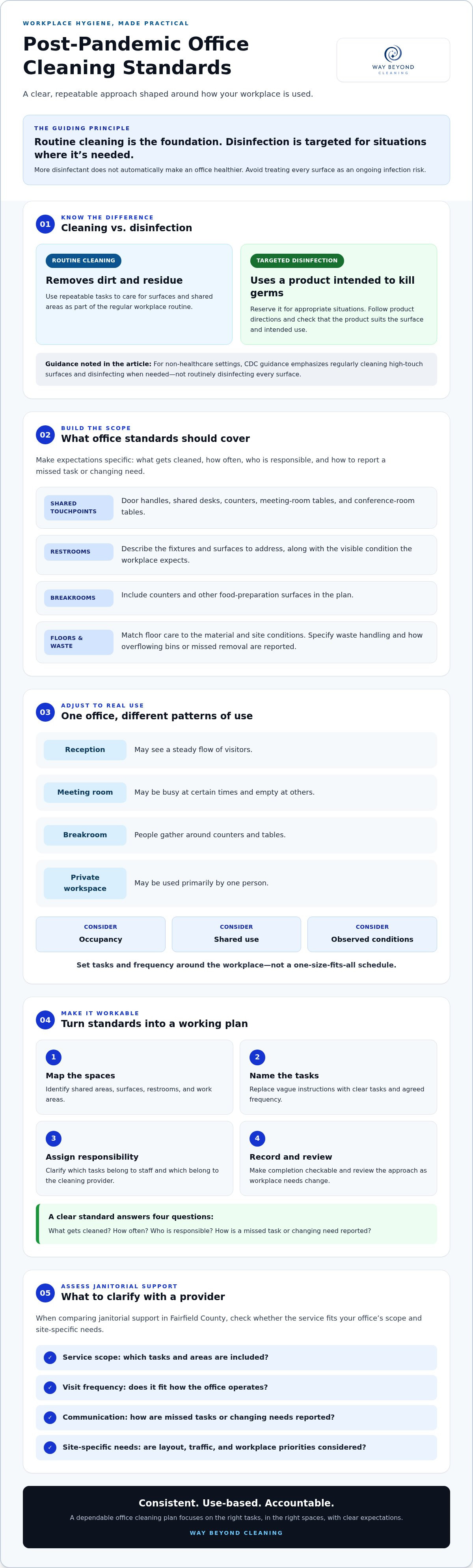
Routine cleaning removes dirt and residue; disinfection uses a product intended to kill germs. For a foundational explanation, see this definition of disinfection. Current CDC guidance for non-healthcare settings emphasizes regularly cleaning high-touch surfaces and disinfecting when needed, rather than routinely disinfecting every surface. That distinction helps offices retain useful hygiene practices without making every touchpoint a special disinfection task.
Why office standards should reflect how spaces are used
Different spaces have different patterns of use. A reception area may see a steady flow of visitors, while a meeting room may be busy at certain times and empty at others. People gather around breakroom counters and tables, while a private workspace may be used primarily by one person. A useful standard accounts for those differences rather than assigning identical attention everywhere.
Use occupancy, shared use, and observed conditions to decide which tasks belong in the plan and when to review them. Fairfield County offices can assess their own layout, traffic, and workplace needs when setting expectations. Another office’s routine may not fit their site.
Consistent, use-based routines direct attention to the spaces and tasks that need it more effectively than blanket measures. Clear documentation also makes expectations easier to communicate and gives managers a practical basis for checking whether the approach still fits.
What Should Modern Office Cleaning Standards Cover?
A useful office standard turns general expectations into clear tasks: what gets cleaned, how often, who is responsible, and how to report a missed task or a changing need. Set the scope and frequency according to how the workplace is used, what staff observe, and the client’s priorities, rather than assuming every office needs the same schedule.
Organize the plan so it’s easy to follow. Grouping tasks by surfaces, shared areas, restrooms, and waste helps managers and cleaning teams understand what “clean” means across the workplace. Professional resources from cleaning industry standards can provide useful context as you shape those expectations.
Routine cleaning for shared office touchpoints
Cleaning removes soil and residue from surfaces; disinfection uses a product to kill germs. Distinguish the tasks in your list so the team knows when routine attention is enough and when targeted disinfection may be appropriate.
For shared touchpoints, name specific examples, such as door handles, shared desks, counters, and conference-room tables. Record the agreed tasks and service frequency, and clarify responsibilities when staff and a cleaning provider share the work. If disinfection is included, check the product’s directions and relevant recommendations from authoritative sources before setting procedures. Product labels matter: don’t assume every disinfectant is suitable for every surface or use.
Restrooms, breakrooms, floors, and waste
For restrooms, describe the fixtures and surfaces to be addressed and the visible condition the workplace expects. Include breakroom counters and other food-preparation surfaces in the plan. Specify how waste is handled in shared rooms and work areas, so overflowing bins or missed removal can be reported and addressed.
Choose a floor-care approach suited to the material and site conditions. Hard flooring may need different care from carpet, and entrances may need attention based on tracked-in dirt or observed wear. Replace vague instructions such as “clean as needed” with the task, agreed frequency, and a way to flag areas that need attention between scheduled visits.
For each area, set three practical expectations: the assigned task, how completion is recorded or communicated, and who receives questions or reports of a missed item. These are planning tools, not universal compliance requirements. Review them when occupancy, shared use, or client needs change.
Offices looking to establish consistent recurring routines can explore professional office cleaning services and discuss a scope and visit frequency suited to their workplace.
Routine Cleaning vs. Disinfection: Choosing the Right Office Approach
Cleaning and disinfection have different purposes. Cleaning removes dirt and residue from surfaces; disinfection uses a chemical product to inactivate germs. A sound office plan identifies the appropriate task instead of treating extra chemical use as proof of a higher standard.
For non-healthcare settings, current CDC guidance emphasizes regular cleaning of high-touch surfaces and disinfection when needed, such as when someone who is sick has been in the space. This risk-based approach helps managers make informed choices without assuming every surface needs routine disinfection.
| Approach | Purpose | Office examples | Decision factors |
|---|---|---|---|
| Routine cleaning | Remove soil and residue | Cleaning a desk, counter, or meeting-room table | Use, visible condition, material, and agreed service scope |
| Targeted disinfection | Use an appropriate product to inactivate germs | Disinfecting a suitable high-touch surface when circumstances indicate it | Current public-health advice, the reason for disinfection, product directions, and surface compatibility |
When is targeted disinfection worth considering?
Start with current public-health guidance for the situation instead of applying one rule to every office. A reported illness in a space may affect the decision, but managers should consult relevant guidance to determine what action is appropriate. Don’t assume disinfection is necessary after every routine use.
Before specifying a disinfectant, check its label for directions, including which surfaces it can be used on and how it should be applied. The product’s intended use matters. If the instructions don’t cover the surface or situation, seek reliable guidance rather than improvising.
How to avoid over-cleaning without lowering standards
Maintain a dependable baseline for regularly used shared spaces, then adjust the plan when occupancy, activities, or observed conditions change. For example, a meeting room used throughout the workday may need more frequent routine attention than a seldom-used private office. That doesn’t automatically mean it needs broader disinfection.
Document the reasoning behind the plan: which areas receive routine cleaning, when targeted disinfection may be considered, and who reviews changes. Clear records help explain why the approach is proportionate and make it easier to update when workplace needs shift. Strong post-pandemic office cleaning standards rely on consistency and sound judgment, not simply using more chemicals.
How to Turn Office Cleaning Standards into a Working Plan
A standard becomes useful when people can follow it, check it, and adjust it as the office changes. Start with a site walkthrough, then turn what you observe into a written scope that clarifies tasks, timing, and ownership. This keeps expectations visible for managers, employees, and any cleaning provider.
- Walk through the office. Map reception, meeting rooms, breakrooms, restrooms, private workspaces, and other areas that need attention. Note the surfaces, flooring, visible wear, and conditions that may affect the cleaning approach.
- Record how each space is used. Consider typical occupancy, shared use, and activities. A meeting room used throughout the workday may need a different routine from a private office that’s occupied less often.
- List existing tasks and responsibilities. Identify what employees already handle and what belongs in the recurring cleaning scope. Clarify who is responsible for restocking supplies, reporting an issue, and following up when a task is missed.
- Agree on a written scope and cadence. Group tasks by space and discuss site-specific service frequencies with the provider. Avoid assuming one schedule will suit every location or area.
- Track completion and review the plan. Use a simple log to note completed work and exceptions, such as an inaccessible room or a reported concern. Review the plan in response to feedback or changes in occupancy and office use, rather than relying on an arbitrary review interval.
Make the schedule easy to communicate
Employees should know what “ready for use” means in shared spaces and where to report a concern. Cleaning teams and managers also need a clear way to communicate when access, site conditions, or changes in office activity affect the agreed scope. A simple process helps small issues reach the right person.
Before finalizing the plan, confirm that each recurring task has an owner, an agreed frequency, and a way to record exceptions. For example, if employees handle restocking while the provider cleans, state that division clearly. Revisit the arrangement when responsibilities or workplace needs change.
Written post-pandemic office cleaning standards can make daily expectations steadier and service conversations more specific. For broader planning, review commercial janitorial services and consider discussing a scope and visit frequency tailored to your workplace.
Choosing Office Cleaning Support in Fairfield County
Some offices can manage everyday upkeep internally, especially when the space is small and responsibilities are clear. But as teams share more rooms, schedules become harder to coordinate, or routine tasks compete with employees’ other work, recurring professional janitorial support may make standards easier to maintain. The right choice depends on your site, priorities, and capacity to oversee the work.
Use your written cleaning scope to compare options. Look for specific tasks and an agreed visit frequency, not broad promises or performance claims that aren’t defined. Ask prospective providers:
- Which spaces and tasks are included, and what falls outside the agreed scope?
- How is completed work communicated, and how can staff report a missed task or concern?
- How are schedule adjustments or changes in office use discussed?
- How will the plan account for your site’s layout, square footage, and particular needs?
Clear answers help you assess whether a proposed arrangement matches the standards you’ve set. They also help distinguish providers with similar-sounding services but different scopes. Confirm how feedback reaches the right contact and how proposed changes are discussed before they affect the routine.
When recurring professional janitorial service may help
A recurring agreement can support consistency by defining the cleaning scope and visit frequency. It may be useful when internal teams struggle to keep shared areas on track or when managers want clearer service accountability. Compare proposals by the work included and how often it’s scheduled, then consider whether that cadence fits how your workplace is used.
Way Beyond Cleaning provides commercial janitorial and office cleaning services in Fairfield County, with recurring service agreements that can be customized by square footage and visit frequency. Businesses can discuss their office needs and clarify a suitable scope for the site. Professional support can also return time to managers and staff, allowing them to focus on their work while cleaning routines follow an agreed plan.
For a closer look at professional office cleaning services, review the service information and consider how a recurring scope could support your office’s post-pandemic office cleaning standards.
Set a Clear Standard for a Calmer Workplace
Effective post-pandemic office cleaning standards don’t depend on disinfecting everything. They establish a dependable routine for shared spaces, distinguish routine cleaning from targeted disinfection, and adapt tasks and frequency to how the office is used.
A written scope makes those expectations practical. Map your spaces, clarify who handles each task, and agree on how completion and concerns are communicated. Review the plan when occupancy, activities, or workplace needs change. That clarity can help employees feel more confident in shared areas while giving managers a consistent basis for oversight.
For offices that need support maintaining a steady routine, Way Beyond Cleaning provides recurring commercial janitorial and office cleaning services. Service agreements can be customized by square footage and visit frequency, so you can discuss an approach that fits your workplace. Explore commercial cleaning services for your workplace and take the next step toward a clean, well-cared-for office.
Frequently Asked Questions
What are post-pandemic office cleaning standards?
Post-pandemic office cleaning standards are documented, repeatable routines for maintaining a workplace, tailored to how its spaces are used. They identify tasks, areas, responsibilities, and agreed frequency, while distinguishing routine cleaning from disinfection. For a Fairfield County office, the plan might account for shared meeting rooms, restrooms, and breakrooms alongside less-used private workspaces. The goal is a clear, practical baseline that managers can review as workplace needs change.
Are offices still required to disinfect every surface?
There isn’t one blanket answer for every office or situation, so avoid assuming every surface must be disinfected routinely. Current CDC guidance for non-healthcare facilities emphasizes regular cleaning of high-touch surfaces and disinfection when needed. Check current public-health guidance for your circumstances, and consider any requirements that apply to your particular workplace. If using a disinfectant, follow its product label, including directions for the surfaces and use in question.
How often should an office be professionally cleaned?
There’s no single frequency that fits every office. Consider how often spaces are occupied, how many people share them, the tasks included in the scope, and observed conditions such as visible dirt or recurring waste. A busy breakroom may call for a different cadence than a lightly used private office. Fairfield County businesses can discuss their square footage, usage patterns, and priorities with a provider to agree on a suitable recurring schedule.
What is the difference between cleaning and disinfecting an office?
Cleaning removes dirt and residue from surfaces; disinfecting uses a product intended to kill germs. These are distinct tasks, and disinfection doesn’t replace cleaning. An office routine might include cleaning a shared counter, with targeted disinfection considered when current public-health guidance indicates it may be appropriate. Check relevant guidance and product-label directions when deciding what to use, how to use it, and whether it suits the surface.
Can routine office cleaning support a healthier workplace?
Routine cleaning supports practical hygiene by removing everyday soil and keeping shared areas, restrooms, and work surfaces orderly. It can also make the workplace feel better cared for and help teams understand which tasks are included. Cleaning alone can’t guarantee that employees won’t become ill, so don’t treat it as a promise of disease prevention. Pair a consistent, site-specific cleaning plan with current public-health guidance relevant to your office.
What should an office cleaning checklist include after the pandemic?
A useful checklist covers shared touchpoints and work areas, restrooms, breakrooms, floors, and waste removal. For each task, specify the area, agreed frequency, and who is responsible, including whether employees or a provider handle restocking or report issues. Note how completion or exceptions are communicated. Review the checklist when occupancy, activities, or observed conditions change, so it remains practical for the way the office operates.
How do I choose a commercial office cleaning service in Fairfield County?
Compare providers by the written scope, agreed visit frequency, communication process, and fit with your office’s layout and needs. Ask which spaces and tasks are included, how completed work or concerns are reported, and how schedule adjustments are handled. Way Beyond Cleaning provides recurring commercial janitorial and office cleaning services, with agreements customizable by square footage and visit frequency. Discuss your Fairfield County workplace’s needs before deciding whether the proposed scope fits.


