

Sensitive offices need clear boundaries around what cleaners may access, not assumptions about what a routine visit includes. Planning high-security office cleaning in Fairfield County starts by defining which areas are in scope, what tasks are approved, and who can authorize entry. If your workplace has restricted rooms, confidential materials, or site-specific procedures, ask exactly who may enter each space and what they are permitted to do.
A practical cleaning plan can support workplace routines while keeping approved shared areas clean and orderly. This guide covers how to document access limits, communicate site instructions, and compare providers using questions about scope, staffing, screening, insurance, and references. It also explains how to make tasks and service frequency clear before work begins, without treating routine cleaning as a substitute for your organization’s security measures.
Way Beyond Cleaning provides commercial janitorial and office cleaning services in Fairfield County. Its commercial agreements can be customized around facility square footage and service frequency. Specialized security procedures are not confirmed as part of its services, so discuss your requirements directly and confirm what the provider can accommodate before granting access. Clear expectations give both parties a practical basis for planning the work.
Key Takeaways
- Define cleaning boundaries using your site’s room classifications and access rules before setting the scope.
- Match tasks and visit timing to occupancy and business operations, then confirm that the proposed schedule works.
- Compare high-security office cleaning Fairfield County providers by reviewing scope clarity, communication, and schedule fit, not just a standard janitorial checklist.
- Before onboarding, gather site requirements, document approved instructions, and review whether the first visits meet expectations.
- Ask Way Beyond Cleaning about your specific requirements. Its Fairfield County commercial agreements can be customized around facility square footage and service frequency.
What High-Security Office Cleaning in Fairfield County Should Mean
A clean workplace supports comfort and daily operations. In an office with sensitive spaces, however, cleanliness does not determine who may enter. Each organization sets its own privacy expectations and access rules. High-security office cleaning in Fairfield County should begin with those boundaries, rather than a generic checklist.
Security-conscious office cleaning is an agreed janitorial scope shaped by the client’s access boundaries; it supports facility operations but does not replace the client’s security program. Routine cleaning may cover approved work areas, while access to restricted rooms requires a separate decision from the organization. The principles of Physical security, including barriers and access control, help explain why cleaning tasks should fit the site’s existing protections rather than bypass them.
Which office areas may need different cleaning boundaries?
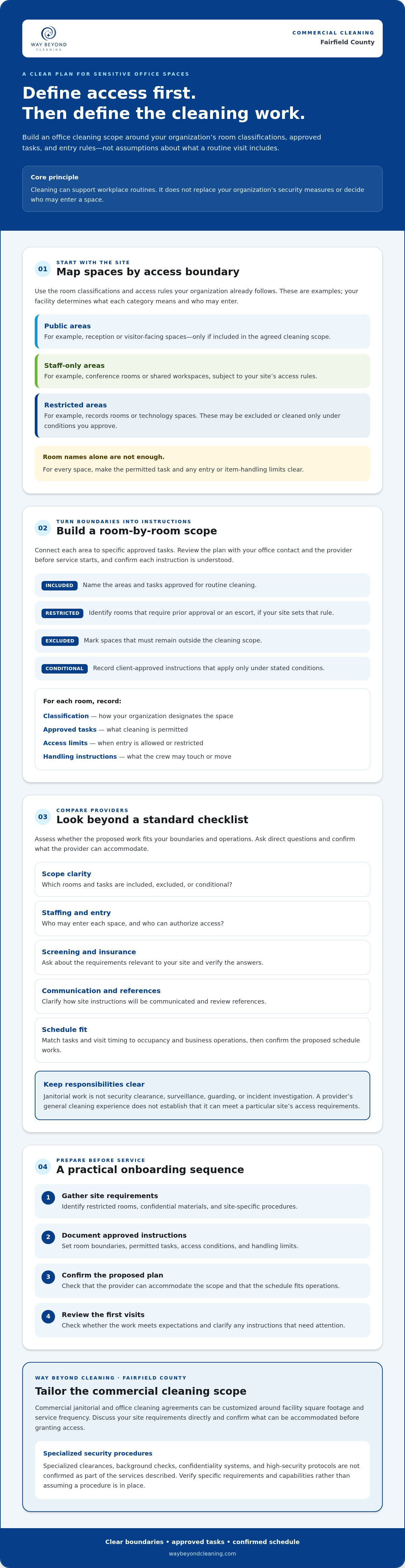
Start with the terms your organization already uses to classify spaces. A practical map might distinguish:
- Public areas: Reception or visitor-facing spaces, if they are included in the cleaning scope.
- Staff-only areas: Conference rooms or shared workspaces, subject to your access rules.
- Restricted areas: Records rooms or technology spaces, which may be excluded or cleaned only under conditions you approve.
These are examples, not assumptions about who may enter. Your facility decides which rooms are included, excluded, or cleaned under supervision, then communicates that decision clearly. Room names alone may not explain the boundary. For each area, document both the permitted task and any limit on entry or handling items.
What a cleaning provider should not promise without confirmation
Janitorial work and security services are different responsibilities. Cleaning should not be presented as security clearance, surveillance, guarding, or incident investigation. A provider’s general cleaning experience is not proof that it can meet a particular site’s access requirements.
Before agreeing to access, ask directly about any employee screening, confidentiality measures, or access-control processes your organization requires. Confirm what the provider can actually accommodate, and ask for clear answers rather than inferring that a procedure exists from a proposal or checklist. Way Beyond Cleaning offers commercial janitorial and office cleaning services in Fairfield County, but specialized clearances, background checks, confidentiality systems, and high-security protocols are not confirmed as part of those services. Share your requirements and verify capabilities before approving entry.
Design Fairfield County Office Cleaning Around Access Boundaries
A useful cleaning plan translates your office’s access rules into clear, room-level instructions. Your organization defines who may enter and under what conditions. The cleaning provider confirms which parts of the requested scope it can accommodate. This helps routine work reflect actual operations instead of relying on assumptions.
Begin with your existing room classifications, then connect each area to specific tasks. For example, list whether a room is included, excluded, or conditional, and spell out what cleaning is approved. This gives the office contact and provider a shared reference before work begins.
Create a room-by-room cleaning and access plan
For each space, record its classification, approved cleaning tasks, access limits, and any handling instructions your organization provides. Be specific about what the crew may touch or move, especially where work materials or equipment need particular care.
- Included: Name the areas and tasks approved for routine cleaning.
- Restricted: Identify rooms that require prior approval or an escort, if your site sets that rule.
- Excluded: Mark spaces that must remain outside the cleaning scope.
- Conditional: Note client-approved instructions that apply only under stated conditions.
Review the plan with your office contact and the provider before service starts. Confirm that each instruction is understood, and settle unclear items before they become on-site decisions. CISA’s physical security resources offer context for why facility-specific boundaries matter. Your organization remains responsible for defining access permissions and site instructions.
Coordinate schedules, keys, and site instructions
Timing is part of the scope. An occupied conference room, active work area, or changing business schedule may make some tasks unsuitable during a particular visit. Discuss which tasks fit the proposed service window and how schedule changes will be communicated. Confirm the timing directly rather than assuming a provider can meet a specific operational condition.
Agree on how entry will be arranged and how keys or other access devices should be returned. If your organization requires key-control or identity-verification procedures, ask whether the provider can follow them and document the answer. Name the person authorized to issue instructions, along with the channel for communicating updates or concerns.
Keep the plan current when rooms, staff, or operations change. Send revised instructions to both the office contact and the provider before they affect a visit. For high-security office cleaning Fairfield County businesses can manage more clearly, a customized commercial cleaning scope can record tasks, frequency, and boundaries together. Review commercial cleaning services as a starting point, then confirm directly which site requirements the provider can accommodate.
How to Evaluate High-Security Office Cleaning Providers
A standard janitorial checklist can show which surfaces a provider plans to clean. It cannot, by itself, establish that the provider can meet your site’s access requirements. When comparing providers for high-security office cleaning in Fairfield County, look at the written scope, communication process, schedule fit, and how directly each provider addresses access boundaries.
Ask for specific answers. A broad assurance such as “we can work with your requirements” does not identify which requirements the provider can accommodate. The Best Practices for Physical Security Resources can provide context for aligning outside services with facility planning, while your organization defines its own rules.
Questions to ask before granting access
Use the same questions with each provider so you can compare responses consistently. Ask which areas and tasks the proposed agreement includes, excludes, or treats as exceptions. Clarify who receives site instructions, how schedule changes will be shared, and what the provider will do if access is unclear. Request direct confirmation about any security-related requirements your organization needs the provider to meet.
| Criteria | Question to ask | Evidence to request |
|---|---|---|
| Scope clarity | Which areas and tasks are included, excluded, or conditional? | A written scope that identifies tasks by area. |
| Communication | Who receives site instructions and reports access concerns? | Documented communication steps and a named point of contact. |
| Schedule fit | Can the proposed visit frequency and timing work with our operations? | A written schedule for review and confirmation. |
| Site requirements | Which of our specified access requirements can you accommodate? | Clear written responses, including any limitations or unresolved items. |
How to assess scope, staffing, and accountability
Check whether the agreement lists cleaning tasks, visit frequency, and who is responsible for supplying or updating site instructions. Ask who will serve as the operational point of contact. Do not assume a particular staffing structure or security procedure. Compare documented commitments with your organization’s requirements, and resolve gaps before selecting a provider or approving access.
For broader commercial janitorial service considerations, review the service overview alongside your site-specific questions. Way Beyond Cleaning serves Fairfield County and offers commercial janitorial and office cleaning services. Confirm directly which access-related requirements it can accommodate before agreeing to a scope.
Prepare Your Fairfield County Office for a Controlled Cleaning Onboarding
A clear start depends on settling important details before anyone enters the workspace. Your organization defines internal access rules and approves instructions for sensitive areas. The cleaning provider confirms which parts of the requested work it can accommodate. Share only the site information needed to perform the agreed tasks, and keep sensitive details within the appropriate internal channels.
Review the site, document access boundaries, confirm the cleaning scope and communication process, then authorize service and review how the first visits went. This sequence gives both parties a practical reference without asking a cleaning provider to define or replace your organization’s security practices.
A practical sequence before the first cleaning visit
Use a simple onboarding sequence to turn site requirements into an actionable plan:
- Gather requirements: Document facility zones, approved tasks, exclusions, preferred schedule, and the designated client contact.
- Discuss access: Explain the arrangements your site requires and ask the provider to confirm which it can meet. Record limitations and unanswered questions.
- Confirm the scope: Review tasks, service frequency, instructions, and how either party will communicate changes. Your organization should approve any guidance involving sensitive spaces.
- Authorize entry: Begin service only after the scope and communication process are clear and your organization has approved access.
Keep the briefing focused. The provider may need to know which areas are included and what tasks are approved, but that does not mean it needs unrelated internal information. If an instruction is unclear or a requirement cannot be confirmed, resolve it before authorizing access rather than leaving staff to interpret it during a visit.
Review and refine the arrangement over time
Onboarding should not end after the first visit. Set a recurring check-in to review completed work, access questions, and changes to rooms or business operations. Decide how concerns should be raised, identify who can approve scope updates, and share revised instructions with the provider before they affect service. Keeping the agreed scope current helps expectations stay clear as the workplace changes.
For Fairfield County office cleaning, consider how the scope fits your facility and preferred service frequency. Way Beyond Cleaning provides commercial janitorial and office cleaning services in the county, with agreements that can be customized around facility square footage and service frequency. Discuss your office’s needs and confirm directly which site requirements the provider can accommodate before arranging access.
Discuss a Tailored Commercial Cleaning Scope with Way Beyond Cleaning
A clear scope discussion helps Fairfield County businesses determine what routine office cleaning can cover and which site requirements need further confirmation. Way Beyond Cleaning provides commercial janitorial and office cleaning services in Fairfield County. Its commercial agreements can be customized around facility square footage and service frequency, providing a practical starting point for discussing your office’s needs.
That customization does not automatically include specialized security procedures. If your workplace has restricted areas or specific access conditions, describe them before agreeing to service and ask the provider to confirm which requirements it can accommodate. For high-security office cleaning in Fairfield County, base decisions on confirmed capabilities, not assumptions.
What information to bring to a cleaning scope discussion
A concise briefing makes the conversation more useful without requiring you to share details that are not needed to plan the cleaning. Prepare:
- Facility size: An approximate square footage for the areas under consideration.
- Service preferences: Your preferred service frequency and operating hours. Discuss and confirm timing directly.
- Task priorities: The routine cleaning tasks that matter most to your workplace.
- Access boundaries: Which areas are restricted, which requirements are mandatory, and who in your organization approves instructions for sensitive spaces.
Ask the provider to confirm in writing which requirements it can and cannot accommodate. Keep those responses with the proposed scope so internal reviewers can compare the documented plan with your organization’s expectations. If a requirement remains unresolved, pause before authorizing access and decide whether to clarify it, adjust the scope, or consider another arrangement.
Choose a local cleaning partner with clear expectations
A suitable scope should reflect your facility’s needs, service frequency, and internal approval process. Do not treat screening, confidentiality, or access-control procedures as part of the arrangement unless the provider verifies them directly. Clear limits help you see where the proposed cleaning agreement fits and where it may not.
Review commercial cleaning services as a starting point, then discuss the details that matter to your site. Fairfield County businesses can contact Way Beyond Cleaning to discuss commercial cleaning needs, preferred schedule, facility size, and access requirements. Confirm capabilities before granting access, and proceed only when the agreed scope is clear.
Set Clear Boundaries for a More Confident Cleaning Plan
Effective high-security office cleaning in Fairfield County starts with access boundaries, not assumptions. Define which areas are included, excluded, or subject to specific instructions, then confirm what the provider can accommodate before granting access. A written scope and clear communication process help align routine cleaning with your operations.
Its commercial agreements can be customized by facility square footage and service frequency, creating a practical basis for discussing your cleaning needs. Specialized security procedures are not confirmed, so share your requirements and verify what the provider can accommodate before making access decisions.
Ready to discuss a tailored scope? Contact Way Beyond Cleaning about your Fairfield County office cleaning needs, including facility size, preferred frequency, and access requirements. Confirm the agreed scope before granting access.
Frequently Asked Questions
What is high-security office cleaning?
High-security office cleaning is a commercial cleaning arrangement planned around a client’s access boundaries, restricted areas, and operating needs. The phrase describes how the cleaning scope is arranged, not a guarantee that cleaners hold security clearances or provide protective services. For high-security office cleaning in Fairfield County, define site requirements first, then ask a prospective provider which tasks and access procedures it can accommodate. Confirm the answers before finalizing the scope or granting access.
How do I choose an office cleaning company for a secure workplace?
Compare each provider’s confirmed commitments with your site’s needs rather than relying on broad assurances. Prepare a written list of access rules, restricted rooms, cleaning priorities, and scheduling needs. Ask how the provider will document the scope, communicate changes, and handle areas it cannot access. Request direct answers about any screening or confidentiality requirements your organization has. Leave unresolved capabilities out of the plan until the provider verifies them.
Should office cleaners enter restricted areas?
Office cleaners should enter restricted areas only when your organization has authorized access and the provider has confirmed it can follow the applicable site instructions. Your facility may exclude sensitive rooms from routine cleaning or set specific conditions for entry. Define those boundaries, communicate them clearly, and include them in the written scope before service begins. Do not rely on informal assumptions or a room’s name to indicate whether access is permitted.
What should a cleaning scope include for a secure office?
A useful scope identifies the areas to be cleaned, approved tasks by area, exclusions, visit frequency, and preferred schedule. It should also name who provides site instructions and explain how the parties will communicate changes or concerns. Add access requirements only after your organization defines them and the provider confirms what it can accommodate. Keep the document focused on information needed for the work, rather than including unnecessary sensitive operational details.
Can a commercial cleaning company guarantee confidentiality or security clearance?
Do not assume a cleaning company provides confidentiality commitments, employee screening, or security clearances. These are distinct requirements, and general cleaning experience does not confirm that a provider can meet them. Ask directly what the company can document and support, then verify any requirement before selecting a provider or authorizing access. If a specific credential or procedure is essential to your organization, treat it as unconfirmed until the provider clearly verifies it.
How often should a high-security office be cleaned?
There is no single cleaning frequency that suits every secure office. Consider occupancy, required tasks, operating hours, and which areas the provider is authorized to enter, then discuss a schedule that fits the agreed scope. Way Beyond Cleaning’s commercial agreements can be customized by facility square footage and service frequency. Contact the company to discuss an arrangement for your Fairfield County workplace and confirm the details directly.
Does Way Beyond Cleaning provide high-security office cleaning in Fairfield County?
Way Beyond Cleaning provides commercial janitorial and office cleaning services in Fairfield County, but specialized security clearances, background checks, and dedicated high-security protocols are not confirmed as part of its services. If your office has controlled-access requirements, explain them and ask which procedures the company can accommodate before proceeding. Confirm capabilities and document the agreed scope before granting access. This helps set realistic expectations for your organization and the cleaning provider.


