

What if office cleaning followed the team’s actual rhythm instead of a fixed calendar? In Fairfield County, hybrid attendance can shift, leaving some cleaning visits out of step with how spaces are used. Flexible janitorial services for hybrid offices start with a practical question: which areas need attention, and how often, to keep the workplace fresh and ready for the people who are there?
A set schedule can feel inefficient when desks sit empty, yet shared kitchens, restrooms, and meeting rooms still need consistent care. The answer isn’t simply to clean less. It’s to align the scope and frequency with patterns of use, then set clear expectations for what each visit covers and how billing is determined.
This guide explains how to assess occupancy, prioritize high-use spaces, and build a workable cleaning plan. It also outlines what to discuss with a local janitorial provider, including scheduling options, square footage, visit frequency, and service scope. Way Beyond Cleaning serves Fairfield County through recurring commercial janitorial agreements, with billing customized according to office size and service frequency. A considered plan can keep the workplace cared for without relying on a routine that doesn’t fit.
Key Takeaways
- Use attendance patterns to inform cleaning frequency, while also considering visible soil and how shared spaces are used.
- Flexible janitorial services for hybrid offices work best when the agreed scope and visit frequency reflect the workplace’s actual needs.
- Compare proposals by documented tasks, billing basis, communication process, and how the plan will be reviewed.
- Map priority areas and assign one point of contact to keep cleaning requests clear and consistent.
- When assessing local support, clarify scope, scheduling, and billing. Way Beyond Cleaning offers recurring commercial janitorial agreements and serves Fairfield County.
Why flexible janitorial services matter in a hybrid office
A fixed cleaning routine can miss the mark when office attendance changes from day to day. A quiet floor may need less attention in some areas, while a busy meeting room or shared kitchen still shows signs of use. As the hybrid work model reshapes how people use offices, cleaning plans work best when they reflect the workplace rather than simply repeat a calendar.
Flexible janitorial services for hybrid offices means agreeing on a clear cleaning scope and visit frequency that suit the office layout and patterns of use. It doesn’t mean unlimited changes whenever attendance shifts. It means making considered choices, documenting them, and knowing how to raise a request if needs change. That clarity supports dependable upkeep and reduces the time employees and office managers spend coordinating service.
What does flexible janitorial service mean for a hybrid workplace?
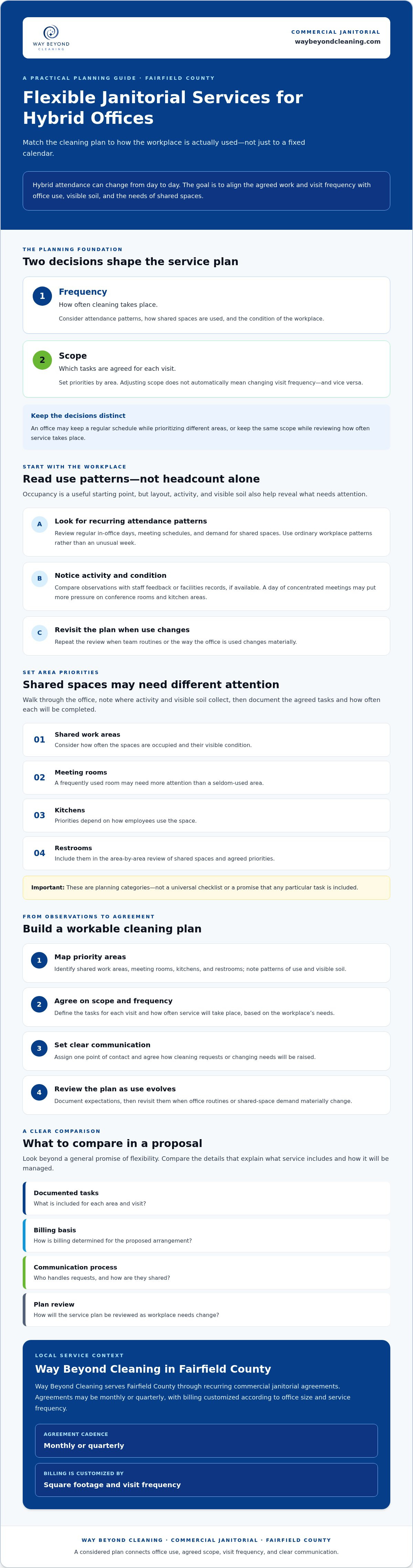
Think of frequency and scope as two separate decisions. Frequency is how often service takes place; scope is the work agreed for each visit. An office might keep a regular schedule while adjusting which areas receive priority, or maintain the same scope while reviewing visit frequency as workplace use evolves. Occupancy alone doesn’t determine which approach is right.
Recurring maintenance is also different from an occasional, more intensive cleaning need. If a project falls outside routine tasks, confirm whether the provider offers it and document the separate scope and terms before work begins. Way Beyond Cleaning’s recurring commercial janitorial agreements may be monthly or quarterly, with billing customized according to square footage and visit frequency. Review its commercial janitorial services and discuss what the agreement includes.
Which office areas need dependable routine attention?
Start with shared work areas, meeting rooms, kitchens, and restrooms. These spaces may serve different numbers of people and functions across the week, so their priorities may differ. A meeting room used often may need more regular attention than a low-traffic workspace, while a kitchen’s needs depend on how employees use it.
There’s no universal checklist that fits every office or automatically defines a provider’s service. Walk through the space, note where activity and visible soil tend to collect, and identify the outcomes that matter most. Then document the agreed tasks for each area and how often they’ll be completed. This turns a broad request for “flexibility” into a practical plan, without adding unnecessary coordination.
How hybrid-office occupancy changes cleaning frequency and scope
Office attendance can shape how quickly shared spaces show wear, where visible soil appears, and which areas see the most use. A meeting room booked throughout the week may need more attention than a seldom-used corner, even if overall headcount is modest. Occupancy is a useful starting point, but it doesn’t tell the whole story. The layout, activities, and condition of each space matter too.
Frequency determines how often cleaning takes place; scope determines which tasks are included at each visit. Keeping these decisions distinct helps teams adjust one without assuming the other must change. That distinction is central to planning flexible janitorial services for hybrid offices around actual workplace needs.
How should an office assess changing attendance?
Look for patterns rather than relying on a single busy or quiet day. Review recurring in-office days, meeting schedules, and demand for shared spaces, then compare those observations with staff feedback or facilities records, if available. For example, a day with concentrated team meetings may put more pressure on conference rooms and kitchen areas than a day with similar attendance but fewer shared activities.
Use observations that represent ordinary office use, and repeat the review when team routines or the way the space is used changes materially. This helps avoid building a service plan around an unusual week.
Which tasks belong in the recurring service scope?
Organize priorities by area rather than assuming every room needs identical attention. A plan might distinguish shared work areas, meeting rooms, kitchens, and restrooms, then identify the agreed tasks for each. These are planning categories, not a universal checklist or a promise that any particular task is included. Ask the provider to state what the recurring service covers, what it excludes, and how additional requests are submitted and reviewed.
For context on how professional cleaning is described across the sector, see ISSA’s overview of commercial cleaning. Its industry perspective can help frame questions, but your written agreement should define the work for your office. You can also explore this commercial janitorial services guide for additional planning context.
Before changing a plan, bring together employee feedback and any available facilities records. If you’re assessing a recurring office arrangement, review Way Beyond Cleaning’s commercial services and clarify the proposed scope, visit frequency, and billing basis with the provider.
How to compare flexible janitorial plans for Fairfield County offices
A proposal is useful only if it makes the work clear. For Fairfield County offices, compare documented tasks and service expectations, not a general promise to be “flexible.” A side-by-side review can show whether each plan fits the office layout, shared-space use, and preferred process for handling service concerns.
| Compare | What to clarify |
|---|---|
| Scope | Which tasks and areas are included, and what is excluded? |
| Visit frequency | How often will service take place, and which scheduling options are confirmed? |
| Billing basis | How do square footage and visit frequency inform the proposed billing? |
| Communication | How are concerns or requests shared, documented, and addressed? |
| Review process | How can the agreed plan be reviewed if workplace use changes? |
What questions reveal whether a plan fits your office?
Ask how the proposed scope reflects the layout and changing use of shared spaces. The plan should make clear what the provider will do in each agreed area, rather than relying on broad descriptions that could mean different things to each party. Confirm how tasks are documented, who receives service concerns, and how follow-up is communicated.
Ask about scheduling adjustments before relying on them. Flexibility doesn’t automatically mean visits can shift at short notice or change day by day. Get the available options and the process for requesting a change confirmed directly.
How should a business compare recurring agreements?
Way Beyond Cleaning offers recurring commercial janitorial agreements that may be monthly or quarterly. Compare these agreement options with your desired service cadence, and ask the provider to distinguish the agreement term from how often cleaning visits occur. The company’s commercial billing is customized based on square footage and service frequency, so clarify how both factors apply to your proposal.
Way Beyond Cleaning serves Fairfield County, along with Litchfield and New Haven Counties in Connecticut and Westchester County in New York. For relevant service details, review Way Beyond Cleaning’s commercial services. A suitable plan sets out scope, frequency, communication, and billing in terms your office can evaluate and revisit.
How to build and review a hybrid-office cleaning plan
A useful plan turns office needs into clear, shared expectations. For flexible janitorial services for hybrid offices, start with the spaces and routines you actually have, then agree on tasks and visit frequency with the provider. A documented scope gives both parties a shared reference, rather than leaving expectations to memory or assumptions.
- Map the space. Note the office layout, approximate square footage, and the areas included in the proposed service.
- Identify priorities. Describe attendance patterns and which shared spaces have the most variable use. Include current concerns, such as areas that become noticeably untidy during busy periods.
- Agree on scope. Separate routine needs from one-time requests. Confirm which tasks apply to each priority area, what falls outside the agreement, and how additional requests will be handled.
- Set the frequency. Share your desired service cadence and discuss what visit schedule fits the agreed scope. Confirm available scheduling options rather than assuming they can change at short notice.
- Review and record. Use staff feedback and facilities observations to decide whether the scope or frequency needs discussion. Document any agreed changes, including when they take effect, so expectations stay aligned.
What information should you share before requesting a plan?
Prepare the approximate square footage, a basic layout, and the service frequency you’re considering. Explain recurring attendance patterns, meeting activity, and spaces whose use fluctuates. A concise list of current concerns helps the provider understand what matters most. Label each request as routine or one-time so a specific need isn’t mistaken for an ongoing expectation.
When should an office revisit its janitorial schedule?
Review the arrangement when attendance patterns, office layout, or business priorities change. Regular feedback can reveal a mismatch: perhaps a shared area needs more attention, while another space is used less than expected. Discuss whether to adjust the scope, frequency, or both. Don’t assume a fixed review interval; agree with the provider on how concerns will be raised and how changes will be confirmed.
Keep communication streamlined. Designate one point of contact to gather employee feedback, prioritize requests, and share them with the provider. This reduces conflicting instructions and creates a clear record of decisions. If you’re ready to discuss your office’s needs, explore Way Beyond Cleaning’s commercial janitorial services.
Choose local janitorial support for your Fairfield-area hybrid office
The right provider should make the practical details easy to understand: which areas and tasks are included, how often visits take place, how billing is determined, and how questions about completed work are handled. Clear answers help you judge whether a proposal fits the way your office operates, rather than relying on a vague promise of flexibility.
Way Beyond Cleaning provides commercial janitorial services and serves Fairfield, Litchfield, and New Haven Counties in Connecticut, as well as Westchester County in New York. For businesses seeking flexible janitorial services for hybrid offices, this local coverage offers a starting point for discussing office requirements. Confirm the specific scope and scheduling options with the provider.
What should Fairfield County businesses confirm with a provider?
Before agreeing to service, verify that your location is within the provider’s service area and review the proposed work in detail. Ask how the scope accounts for your layout and shared-space use, how often visits are planned, and how the billing basis is determined. Also clarify how to raise questions or share feedback if completed work doesn’t match the documented expectations.
Use the answers to compare providers on specifics, not general assurances. A useful proposal should show what’s included, what falls outside the agreement, and how changes or concerns will be discussed. For related workplace guidance, read this professional office cleaning guide.
What is the next step toward a tailored janitorial plan?
Prepare a concise brief before speaking with a provider. Include approximate square footage, a basic office layout, attendance patterns, areas with variable use, and the service frequency you’re considering. Separate recurring priorities from one-time requests so the discussion can focus on everyday needs. Then ask which scheduling options are available for your office rather than assuming visits can shift on demand.
Way Beyond Cleaning’s recurring commercial janitorial agreements may be monthly or quarterly, with billing customized according to square footage and visit frequency. You can learn more about Way Beyond Cleaning’s company background as you assess local support. To discuss your office requirements and confirm available scheduling, review its commercial janitorial services as a next step.
Build a cleaning plan that works with your office rhythm
A hybrid workplace doesn’t need a one-size-fits-all routine. The most useful plan separates visit frequency from the tasks included, then bases both on how employees use the office. Clear documentation, a single point of contact, and periodic reviews help keep expectations aligned as attendance and workplace priorities shift.
Flexible janitorial services for hybrid offices should make upkeep easier to manage, not add another layer of coordination. Compare providers by documented scope, scheduling options, communication process, and billing basis. Way Beyond Cleaning is locally owned and operated, was founded in 2020, and serves Fairfield, Litchfield, and New Haven Counties in Connecticut, along with Westchester County in New York. Its commercial billing is customized according to square footage and service frequency.
Bring your office layout, priorities, and preferred service cadence to the conversation, then confirm which scheduling options are available. Discuss janitorial service for your office and take the next step toward a workplace that feels cared for, whatever the weekly rhythm.
Frequently Asked Questions
What are flexible janitorial services for hybrid offices?
Flexible janitorial services for hybrid offices use an agreed cleaning scope and visit frequency suited to how the workplace is used. Flexibility means the plan can be discussed and reviewed as needs change, not that visits or tasks can change without agreement. Document which areas and tasks are included, how often service takes place, and how both parties will communicate about requests or concerns.
How often should a hybrid office be professionally cleaned?
The right frequency depends on how employees use the office, including attendance patterns, meeting activity, and demand for shared areas. A busy kitchen or frequently used meeting room may need different attention from a lightly used workspace. Review actual conditions and staff or facilities feedback, then discuss a suitable cadence with a janitorial provider. Confirm which tasks are included at each visit rather than assuming frequency defines the scope.
Can janitorial services be adjusted when office attendance changes?
Adjustments may be possible, but confirm the provider’s scheduling options and request process before relying on them. A change in attendance could lead you to discuss visit frequency, the tasks prioritized within the agreed scope, or both. Record any approved changes so the office and provider share clear expectations. Don’t assume service can shift day by day or at short notice unless the provider confirms that arrangement.
What should hybrid-office janitorial services include?
The included work should be clearly documented and based on the office’s layout and priorities. During planning, consider shared work areas, meeting rooms, kitchens, and restrooms, and ask what tasks are proposed for each. There isn’t one universal checklist that fits every workplace. Have the provider clarify included tasks, exclusions, and how to submit requests for work beyond the recurring agreement.
How is commercial janitorial service billing determined?
Billing depends on the provider’s terms and the details of the proposed service. Way Beyond Cleaning customizes commercial billing according to square footage and visit frequency. Ask how those factors apply to your office and review the scope alongside the billing basis, so you understand what the recurring arrangement covers. The company’s recurring commercial janitorial agreements may be monthly or quarterly.
Does Way Beyond Cleaning serve hybrid offices in Fairfield County?
Way Beyond Cleaning serves Fairfield County and offers commercial janitorial services that offices can discuss based on their workplace needs. The locally owned and operated company was founded in 2020 and also serves Litchfield and New Haven Counties in Connecticut and Westchester County in New York. Contact the provider to discuss your office’s scope and frequency, and confirm which scheduling options are available for your location.


