

A visiting executive forms an indelible judgment about your organization in just 100 milliseconds. Before you present a single slide or exchange formal greetings, your physical environment speaks on your behalf. You already know the relentless effort required to build market authority, yet it's easy to overlook how profoundly client perception and office cleanliness intertwine. A lingering conference room odor, smudged entryway glass, or an overlooked restroom flaw quietly undermines your authority, prompting prospects to question your operational discipline before negotiations even begin.
True facility presentation isn't passive maintenance; it's an active reflection of organizational wellness and precision. In this comprehensive guide, you'll discover how immaculate workspace presentation shapes executive trust, client perception, and commercial deal outcomes. We unpack the cognitive science behind high-stakes first impressions, share a perception-based facility audit framework, and demonstrate how reliable, high-standard commercial janitorial care protects your enterprise prestige.
Key Takeaways
- Understand how client perception and office cleanliness trigger the psychological Halo Effect, prompting executive visitors to equate pristine environments with operational excellence.
- Discover why sensory architecture, from purified air quality to residue-free conference tables, builds subconscious confidence and executive trust.
- Identify high-stakes assessment zones, particularly executive restrooms and meeting rooms, where subtle maintenance oversights threaten brand reputation.
- Learn how to conduct a structured visitor-journey audit to uncover blind spots before critical stakeholder walk-throughs.
- Establish verifiable commercial janitorial standards with a reliable partner to safeguard corporate prestige and enhance client retention.
The Psychology of First Impressions: How Office Cleanliness Shapes Client Perception
When an executive enters your commercial facility, their cognitive evaluation begins instantly. Human psychology dictates that visitors form lasting impressions within seven seconds of crossing an office threshold. In high-stakes corporate interactions, client perception and office cleanliness are inextricably linked; your physical workplace serves as an immediate proxy for your operational excellence. An immaculate corporate environment doesn't just look visually appealing. It conveys fiscal stability, organizational discipline, and genuine respect for visiting stakeholders.
The Halo Effect in B2B Client Meetings
Commercial decision-makers rarely evaluate a facility in isolation from the business operating within it. Through the psychological halo effect, visiting executives unconsciously project visible physical order onto the unseen quality of your work product. When prospects encounter an uncluttered, tranquil boardroom with pristine surfaces and fresh air, they infer that your project governance, client reporting, and deliverables carry the same meticulous precision. Conversely, visible disorder triggers silent assumptions regarding sloppy project management, planting seeds of doubt before your formal pitch even starts.
Subconscious Trust Markers in Executive Workspaces
Long before an executive reads your proposal, they absorb subtle environmental cues. Cleanliness operates as an unwritten, non-verbal sales presentation that quietly reassures decision-makers. Key visual and environmental markers define how client perception and office cleanliness influence critical meetings:
- Threshold clarity: Smudge-free glass doors and immaculate reception counters establish an immediate standard of corporate pride and organizational control.
- Tactile surface hygiene: Boardroom tables completely free of dust, paper clutter, or sticky residue provide an inviting environment designed for high-level strategic focus.
- Architectural precision: Spotless baseboards, dust-free corners, and sanitized common rooms signal relentless governance across every square foot of your enterprise.
Maintaining a spotless workplace eliminates subconscious friction. It transforms your corporate office into a sanctuary of executive calm, reassuring clients that their commercial partnership rests in capable hands.
Sensory Architecture: How Visual, Olfactory, and Tactile Details Drive Perception
When evaluating client perception and office cleanliness, visual appearance is merely the opening chapter. True environmental quality engages sight, scent, and touch simultaneously. Scientific research into subconscious influences on perceived cleanliness reveals that subtle environmental cues shape how visitors assess competence and service standards. When every sensory element aligns, a workplace transitions from a standard corporate office into an inspiring sanctuary of focus.
Visual Clarity and the Elimination of Micro-Clutter
Streaks across architectural glass partitions catch the eye immediately. They scatter natural light and signal deferred maintenance. Micro-clutter operates the same way. When fine dust gathers on window ledges, baseboards, or credenzas, it tells visitors that small details go unnoticed. Crisp sightlines provide cognitive ease. A serene reception area with immaculate surfaces relaxes arriving guests, setting an orderly tone before formal discussions begin.
Olfactory Impact: Natural Freshness Versus Masking Agents
Artificial fragrances don't hide poor hygiene. Heavy synthetic aerosols and perfumed plug-ins often suggest underlying neglect, prompting discerning guests to wonder what those scents are masking. Authentic cleanliness smells like nothing at all. Neutral, purified air achieved through prompt contaminant removal and HEPA filtration relieves respiratory fatigue. It protects visitor wellness, keeping minds clear during intense negotiations.
Tactile Standards for High-Touch Conference Rooms
Tactile feedback confirms or shatters visual promises. Picture a visiting stakeholder settling into an executive boardroom. If their forearm meets a sticky table edge, or if a conference chair feels grimy, mutual goodwill evaporates instantly. The dynamic between client perception and office cleanliness becomes acutely physical at the negotiating table. High-touch surfaces demand specialized care:
- Residue-free board tables: Polished surfaces should feel smooth and completely clean, free from chemical film or grease.
- Refreshed executive seating: Upholstery and leather armrests must be routinely sanitized to ensure comfortable, distraction-free seating.
- Sanitized technology: Presentation displays, touchscreens, and remotes require deliberate disinfection to convey thoughtful stewardship.
Every touchpoint tells a story about your standards. Investing in recurring, wellness-focused commercial janitorial services ensures these critical sensory details consistently reinforce your brand prestige.
The Critical Assessment Zones: Where Corporate Reputations Are Won or Lost
While executives appreciate architectural design, they evaluate corporate integrity in private spaces. A stunning lobby cannot rescue an engagement if secondary touchpoints show neglect. Client perception and office cleanliness converge most intensely in functional zones where visitors expect flawless hygiene. When organizations treat secondary corridors and personal amenities with the same dedication as the boardroom, visitors notice immediately.
The Commercial Restroom as an Operational Litmus Test
Restrooms serve as an uncompromising corporate litmus test. According to the Bradley Company Healthy Handwashing Survey, 86% of U.S. adults expect the quality of an organization's restrooms to mirror the quality of its goods and services. A surprising 40% of visitors deliberately inspect these facilities before deciding to conduct business. Stained tile grout, lingering moisture, or clouded chrome instantly fracture visitor confidence. Spotless mirrors, polished fixtures, and continuous odor neutralization demonstrate self-respect and thorough governance.
The Executive Boardroom and Technology Interfaces
Boardrooms require exceptional turnaround care. While general administrative desks handle routine daily tasks, conference spaces endure close scrutiny under intense directional lighting. Lingering conference room odors or stale air distract from vital discussions; aligning your facility standards with the EPA guide to office indoor air quality helps preserve crisp ventilation. Specific high-risk hardware items include:
- Digital displays and glass boards: Fingerprints and faint dry-erase shadows distract from presentation materials during strategic pitches.
- Central phone and control interfaces: Shared tabletop consoles harbor oil and micro-particles, demanding regular sanitizing.
- Pedestals and seating bases: Visible shoe scuffs along conference table legs signal superficial cleaning routines to anyone seated around the perimeter.
Entryways, Foyers, and Transition Thresholds
Your exterior threshold orchestrates the opening sequence of a client visit. Streaked entrance glass or curled, salt-stained floor runners immediately pull focus away from your brand message. Elevators and reception lobbies demand steady, disciplined care to keep transition spaces immaculate. Partnering with tailored commercial janitorial services ensures high-traffic zones receive continuous restorative maintenance, turning every entryway into an asset that reinforces client perception and office cleanliness.
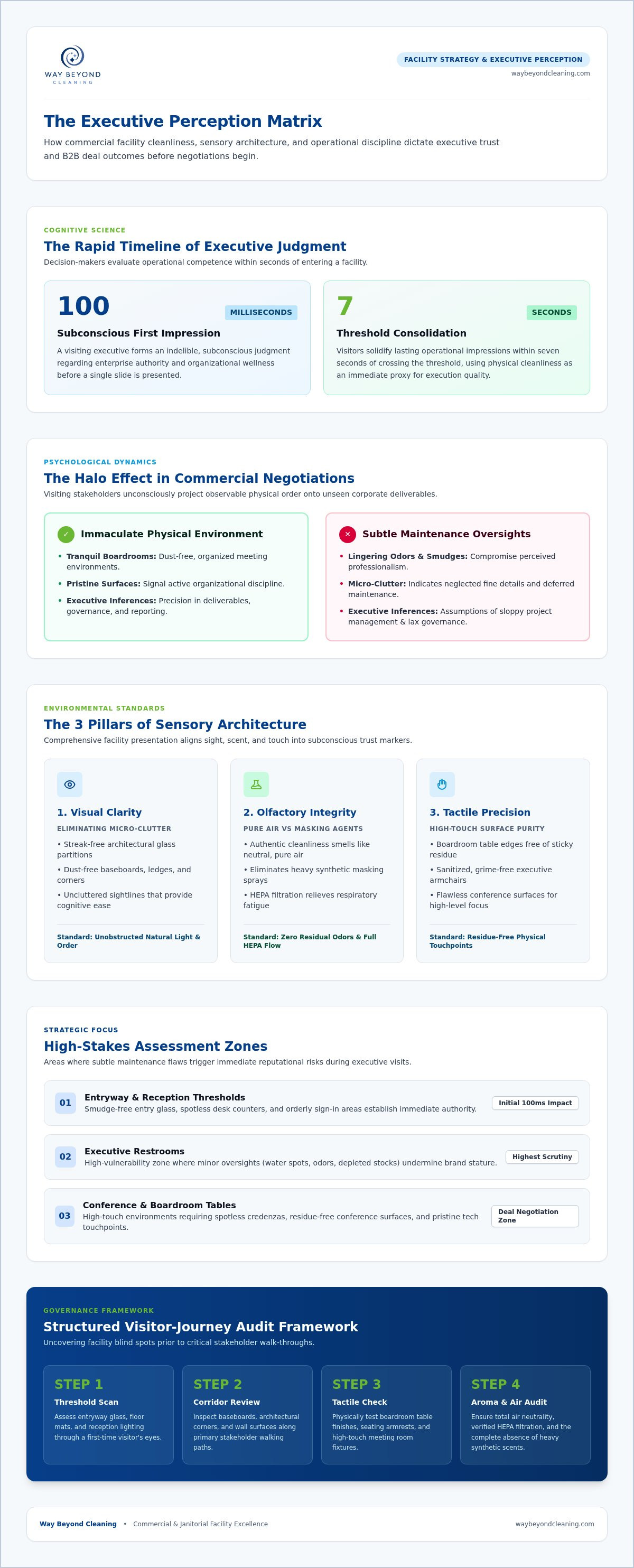
Designing a Facility Cleanliness Audit from the Visitor Perspective
Daily familiarity breeds environmental blindness. When leaders walk the same hallways each morning, subtle signs of facility wear quietly fade into the background. A structured walkthrough strips away that routine familiarity. By stepping into the shoes of a first-time prospect, facility managers uncover hidden liabilities before high-profile meetings take place. Documenting these checkpoints establishes objective accountability across custodial operations, protecting interior assets and reinforcing the vital connection between client perception and office cleanliness.
Step 1: The External Approach and Arrival Sequence
Begin your evaluation right where the visitor journey starts: the exterior approach. Check access walkways, structural framing, and entryway branding for windblown debris, cobwebs, or mineral spotting. Test exterior door handles for physical tackiness and mechanical cleanliness. Walk-off mats must sit flat and vacuumed clean, without salt crusts or frayed edges. For regional frameworks, review our insights in Professional Office Cleaning in Fairfield, CT to align facility benchmarks with client expectations.
Step 2: The Lobby Horizon and Eye-Level Inspection
Step inside the reception foyer and pause at standing eye level. Scan horizontal surfaces, check-in desks, and guest seating areas for dust deposits or drink rings. Look upward to verify that overhead supply vents and recessed light baffles remain free from dark particulate buildup. When hospitality counters are immaculate and literature stands sit neatly organized, arriving partners enjoy immediate cognitive ease.
Step 3: The Deep-Dive Restroom and Boardroom Inspection
Conclude your audit in the private spaces that command the closest scrutiny. In executive restrooms, inspect floor drains, partition latches, and tile perimeters where standard mop sweeps often push grime. In conference spaces, check table undersides, chair bases, and clustered presentation cables for overlooked dust. High-intensity lighting should reveal streak-free surfaces across every architectural element.
Structured audits eliminate guesswork and safeguard your brand prestige before key stakeholders arrive. To replace maintenance uncertainty with verified operational standards, schedule a tailored commercial walk-through with our team today.
Elevating Your Commercial Image with Way Beyond Cleaning
Way Beyond Cleaning reimagines commercial facility care as a core driver of executive prestige. Founded in 2020, our organization transforms corporate offices into sanctuaries of calm focus, ensuring that client perception and office cleanliness work in unison to validate your enterprise authority. We don't view commercial care as routine maintenance; we treat it as an active operational safeguard. Discover our founding values on our about page, and explore our tailored solutions in Commercial Janitorial Services in Fairfield, CT.
Wellness-Driven Janitorial Protocols for Modern Enterprises
Cleanliness should protect human vitality without introducing abrasive chemical odors. Our trained commercial teams deploy eco-conscious formulations that lift residues without polluting indoor air. Advanced HEPA filtration systems actively eliminate airborne dust and particulate matter, visibly brightening each room while supporting respiratory wellness. From fine architectural millwork to imported marble surfaces, precision care protects your enterprise assets while projecting an unmistakable aura of prestige.
Tailored Contract Maintenance Across Fairfield and Westchester
Generic cleaning checklists fail to address the dynamic cadence of corporate operations. Serving Fairfield, Litchfield, and New Haven Counties in Connecticut alongside Westchester County, New York, we design bespoke recurring commercial janitorial contracts structured around your exact traffic volume and square footage. Dedicated on-site supervision guarantees unwavering consistency every single evening, operating discreetly so normal business routines remain completely undisturbed. For additional corporate capabilities, explore our guide to Specialty Cleaning Services in Fairfield, CT.
Reclaiming Leadership Focus Through Flawless Facility Care
Executive leadership requires uncompromised concentration. Managing erratic janitorial contractors, inspecting supply closets, or worrying about restroom cleanliness drains precious mental bandwidth. Delegating facility care to a conscientious commercial partner allows leadership teams to reclaim their most valuable currency: time. By mastering the synergy between client perception and office cleanliness, you can greet arriving board members, prospective investors, and valued clients with absolute, quiet confidence.
Positioning Your Facility for Unwavering Executive Confidence
Immaculate facility presentation is an active investment in your firm's brand equity. When every sensory element aligns, from purified indoor air to spotless boardroom glass, visiting stakeholders immediately recognize an environment guided by discipline and precision. Mastering client perception and office cleanliness ensures that your physical surroundings continually reinforce the integrity of your executive work.
You shouldn't have to sacrifice valuable leadership focus managing maintenance inconsistencies. Serving corporate leaders across Fairfield and Westchester Counties, Way Beyond Cleaning delivers wellness-first janitorial protocols that protect executive reputation every single day. Through fully customized recurring commercial contracts tailored to your facility, our dedicated teams handle the finest details so your leadership can focus entirely on enterprise growth. Elevate your corporate workspace with Way Beyond Cleaning and welcome every client with total peace of mind.
Frequently Asked Questions
How quickly does office cleanliness affect a visiting client's initial perception?
Initial impressions form within seconds of crossing an office threshold. Subconscious evaluations begin the moment a guest reaches for an exterior entryway handle or steps into the lobby foyer. This immediate assessment triggers cognitive biases that color subsequent business conversations. Maintaining pristine public spaces ensures that client perception and office cleanliness establish an instant foundation of trust and operational competence before formal discussions even start.
What are the most common office cleaning details missed by standard janitorial crews?
Standard custodial crews don't always catch micro-details while rushing through broad floor sweeps and trash disposal. Commonly neglected areas include dusty HVAC diffusers, smudges on architectural glass partitions, sticky conference table undersides, and scuffed table pedestals. In restrooms, missed touchpoints frequently include partition latches, flush handles, and tile grout lines around floor drains. Addressing these subtle secondary zones separates routine maintenance from executive-level presentation.
Can a poorly maintained office space directly influence business deal outcomes?
A neglected workplace directly threatens commercial negotiations. Corporate prospects unconsciously correlate physical maintenance with operational governance and internal attention to detail. When prospective partners encounter clouded windows, dusty electronics, or unpleasant facility odors, they often assume your back-office reporting and project management share that same lack of discipline. A pristine commercial facility removes subconscious friction, instilling the confidence required to close high-value partnerships.
How does professional commercial cleaning improve employee productivity and client retention?
Clean workplaces elevate employee morale and physical vitality by eliminating airborne allergens, surface microbes, and distracting visual clutter. For corporate facilities across Fairfield County, maintaining spotless environments demonstrates genuine care for both internal teams and external stakeholders. Clients enjoy returning to spaces that feel fresh and orderly, which fosters lasting business relationships and protects ongoing contract renewals through unspoken standards of excellence.
What is the difference between basic surface cleaning and wellness-driven janitorial care?
Basic cleaning merely empties bins and wipes central counters, often relying on heavy artificial fragrances to mask lingering odors. Wellness-driven janitorial care prioritizes human health, sensory harmony, and architectural preservation. This advanced methodology combines hospital-grade HEPA filtration to purify indoor air with eco-conscious cleaning solutions that leave no sticky residues behind. It treats the corporate workspace as an active sanctuary for daily productivity and client trust.
How often should corporate conference rooms and restrooms undergo professional deep cleaning?
High-traffic executive restrooms and conference suites require dedicated daily maintenance alongside scheduled recurring deep cleans. In active Fairfield County corporate facilities, baseline daily sanitization keeps touchpoints fresh, while monthly or quarterly restorative cleanings protect grout, carpet fibers, and delicate millwork. Establishing a customized janitorial schedule aligned with foot traffic ensures that client perception and office cleanliness remain uncompromised during unexpected or high-profile visitor walk-throughs.


